
Is Your Building's Foundation Moving? What You'll Probably Notice First
Maybe you've been shouldering the back door shut for a few weeks now. Or you spotted a thin crack climbing out of a window corner and couldn't remember whether it was there last spring. Both are common, and most of the time the reason is dull. Every so often it isn't, and the annoying part is that on day one the two cases look almost identical.
We're Piling Pros. We install helical piles and micropiles around South Florida, so by the time we're standing on a property an engineer has usually been there already. This post is about the stretch before that call: what you can see from your own hallway, what it might mean and what it might not, and a few things you can do this week while you wait to find out.
Table of Contents
Reading cracks without playing engineer
Why South Florida is its own case
Terms Worth Knowing Before a Foundation Report Lands on Your Desk
When it's probably not the foundation
What owners notice first
Nobody stands in the yard admiring a foundation. You notice the stuff bolted to it, and that's why the first clues are so ordinary: a door you have to lean on, a window that won't slide, a hairline crack over the garage that you only saw because the afternoon light hit it right.
The UC Davis geotechnical photo album lists doors and windows that won't open among the things differential settlement causes, next to cracks and, in the bad cases, structural damage. One sticking door doesn't prove anything, though. Here's how the usual clues line up against the usual innocent explanations.
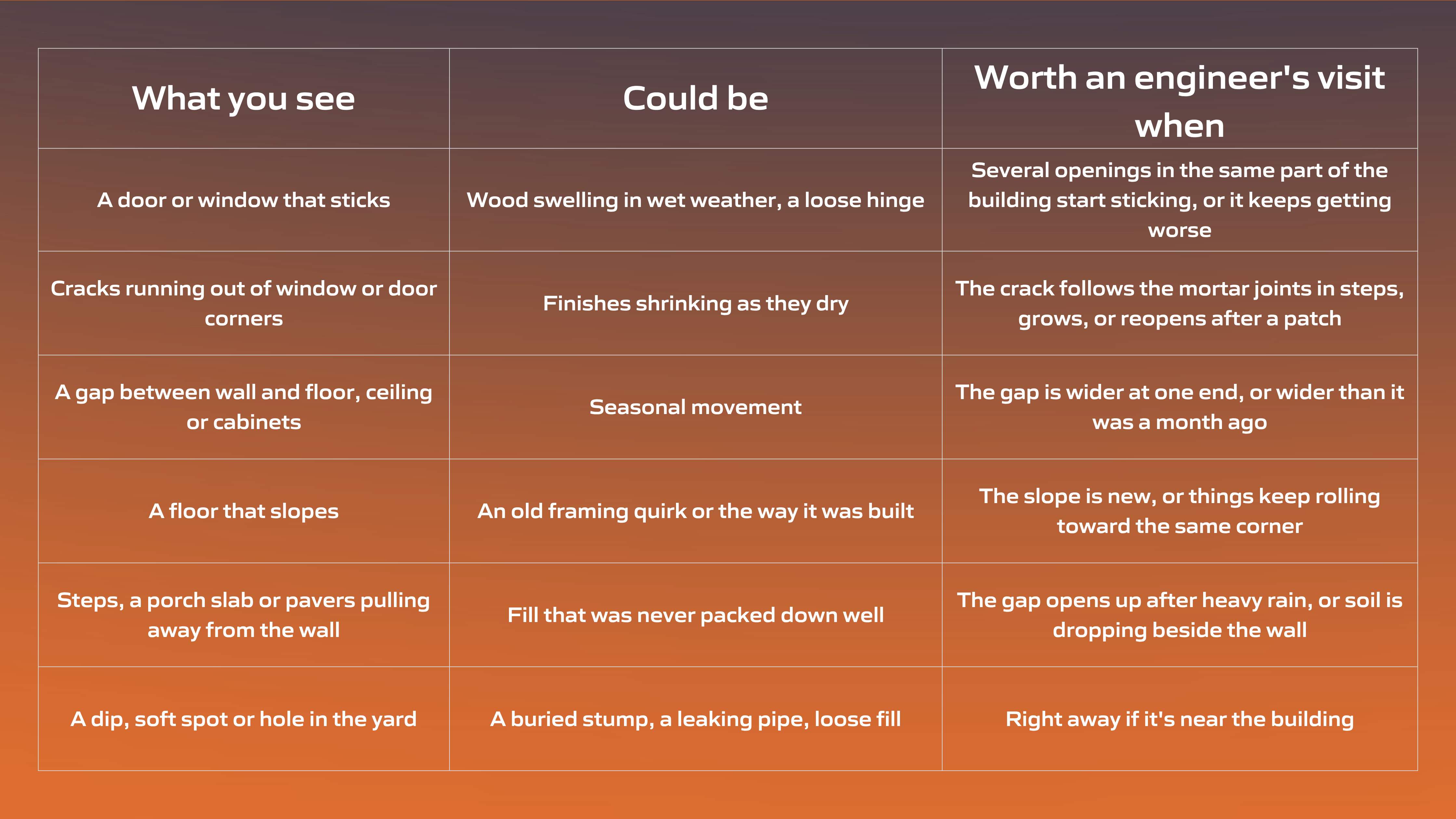
If you want to know which way a floor falls, set a marble on it. It'll roll downhill and tell you nothing about whether the slope is new, so write down the date and where it ended up.
Reading cracks without playing engineer
Cracks get most of the worry, and some of that is deserved. The UC Davis page says they often start at the corners of windows and doors because stress piles up there, and in brick a diagonal crack off a door corner follows the mortar joints, since mortar is the weak link in the wall. A crack that steps across brick like a staircase is just taking the easiest route it can find.
You can't read a whole diagnosis out of a crack, and you shouldn't try. What you can do is notice the pattern, and notice whether it's changing. A crack that has looked the same for three years is a different animal from one that's longer than it was last month. If you patch one and it opens again, tell the engineer, because that suggests whatever caused it hasn't stopped.
Be wary of anyone who hands you a single crack width as a rule, like "over this much and you're in trouble." The call depends on the building, the pattern and whether the thing is still moving. Neither of the sources we read for this post gives a number, and we're not going to make one up.
Why South Florida is its own case
A lot of the ground here is soft and sandy, and the water table sits near the surface, so a foundation has less to push against than it would in stiffer soil. Our post on Florida soil conditions and foundation design covers how that changes the engineering. If somebody is digging next door, dewatering is worth a read too, since pulling water out of the ground changes how the ground behaves.
Then there's the limestone underneath. The Florida Department of Environmental Protection's sinkhole FAQ describes three kinds of sinkhole in the state: solution sinkholes, where rock dissolves near the surface; cover-subsidence sinkholes, where sediment slowly ravels down into a void and leaves a gentle round dip; and cover-collapse sinkholes, where the ground gives way all at once. The same page says activity is greatest after a stretch of drought followed by a return to normal rain.
Before anyone panics, it's worth knowing the page also says a lot of settling isn't a sinkhole at all. It lists compressing clay or organic layers, rotting stumps and debris, broken sewer or drain pipes, a cracked septic tank, and soil that wasn't packed down well after digging. A depression gets called a "subsidence incident" until a licensed professional geologist or engineer confirms what it is, and most reported ones never get confirmed as sinkholes.
Terms Worth Knowing Before a Foundation Report Lands on Your Desk
Once an engineer gets involved you'll hear a handful of words, and nobody explains them well, so here they are without the textbook voice.
Differential settlement means one part of a building sinks more than another. If the whole thing drops evenly you might never notice. The uneven kind is what cracks walls and jams doors. A geotechnical report is a study of the ground itself, usually built on soil borings, and it tells everybody what the foundation is sitting on. A structural engineer looks at the building and a geotechnical engineer looks at the soil, and a real diagnosis often needs both of them talking.
A crack monitor, sometimes called a crack gauge, is a small device stuck across a crack so you can see over a few weeks whether it's opening. Monitoring in general just means measuring on a schedule instead of guessing, and our post on instrumentation and monitoring shows what that looks like on bigger jobs. Subsidence is a general word for ground that has sunk, and FDEP uses "subsidence incident" for a reported depression nobody has confirmed as a sinkhole yet.
What to do this week
Grab your phone. Photograph every crack that bothers you with a coin or a tape measure next to it so the size is obvious, and keep the date on the photo. Then take a pencil and mark both ends of the crack, writing the date beside each mark. Look again in a month. If the crack has crept past the pencil, you have something an engineer will want to see, and it tells them more than a description over the phone can.
While you wait, walk the outside of the building. Look for a downspout that empties right against a wall, a patch of lawn that feels spongy, anything that smells like a sewer line. FDEP lists broken drain and sewer pipes among the things that can make ground sink, so a leak could turn out to be the whole story, and a leaking pipe is a far easier thing to fix than a foundation.
Then get a licensed engineer out there, somebody who will look at the structure and the soil and sign their name to what they find. Skip the contractor who quotes a repair on the first visit. Nobody has said what's wrong yet, so what exactly would they be pricing?
FDEP has a short list for the scary case. If a hole is affecting the building and walls are sinking, sagging or cracking, stay out and call your property insurance adjuster right away. Life or property in immediate danger means 911. And don't pour water into the hole, because that can make it bigger.
When it's probably not the foundation
Say the back door in some house sticks every August and swings free by January. That's wood soaking up humidity and letting it go, and the building is fine. The same goes for hairline cracks in paint and plaster, which turn up in perfectly sound buildings, and for a floor that was a bit off level from the day it was built. A bathroom door that sticks because the bathroom is damp is just a door.
Where it changes is the pattern. Three openings on the same side of the house, a crack that's longer than it was last month, a gap opening along the porch: put those together and it's time to call someone. Neither source we read gives a symptom checklist you could use instead of an engineer, so we aren't going to hand you one.
How Piling Pros approaches foundation support
Our part usually starts after an engineer says the building needs deeper support. Before anything gets mobilized we read what's already on paper: the plans, the geotechnical data, the soil profile, the water table. Then we look at the site itself, mostly how a crew and a rig can physically get in and what limits the property puts on the work. The system gets picked from there, the crew and equipment head out, and the owner hears from us until the job is finished.
Which system depends on the site. Helical piles, as our page puts it, are a screw-in system for restricted access, soft soils and low vibration. Micropiles are small-diameter, drilled and grouted, and they suit tight access and difficult ground. Picture a packed commercial block with no room for a big rig sitting next to an open residential lot, and you can see why those two shouldn't end up with the same answer. If you want the longer story, our post on what causes foundation problems that require piling covers causes, and why buildings experience foundation problems covers how choosing the right fix keeps the problem from coming back.
Mistakes
The big one is waiting. A sticky door turns into a door that won't close, a hairline crack turns into one you can slide a credit card into, and the sooner somebody looks, the more choices you usually have.
Patching and painting over a crack without finding out why it happened comes next. The wall looks better, you've learned nothing, and if the movement continues the patch can open right back up.
Then there's the quote-first approach, where somebody prices a repair before anyone has diagnosed anything. You can't know what the fix should be until you know what's wrong.
And please don't assume insurance will handle it. The FDEP page says property insurance may pay for testing and repairs when a sinkhole is involved but may not cover settling from other causes, so ask your insurer early, before you've spent anything.
Frequently Asked Questions
Are cracks in a foundation always a big deal?
No, plenty of them are harmless. What matters is the pattern, how wide the crack gets over time, and what kind of building it's in, so the smartest first move is to start tracking it and hold off on deciding anything.
Can I just patch it myself?
You can fill the surface of a crack. You can't fix whatever caused it that way, and a fresh patch can cover up the exact thing an engineer would want to look at. If you're going to patch anyway, photograph and date it first.
Do I call an engineer or a contractor first?
An engineer.
They can look at the structure and the soil, say in writing what's going on, and then you've got something solid to hand any contractor who bids on the work. Going the other way around means you're comparing prices for a problem nobody has named yet.
Could my house be sitting over a sinkhole?
In Florida it's a fair question. Florida DEP says most settling isn't a sinkhole and most reported incidents never get verified as one, and that a licensed professional geologist or engineer is who can say. If a hole is opening up near the building, though, treat it as urgent and call your insurance adjuster, as in the steps above.
Is this covered by insurance?
It depends on your policy and on what's causing the problem. FDEP says insurance may cover testing and repairs once a sinkhole is confirmed and may not cover settling that comes from something else. Read the policy and phone your insurer before any work starts.
What to Do Next
Already holding an engineer's report that says the building needs deeper support? Or still weighing your options before a project begins? Either way, send Piling Pros your project details and tell us about the site. We'll tell you what we'd look at first.