
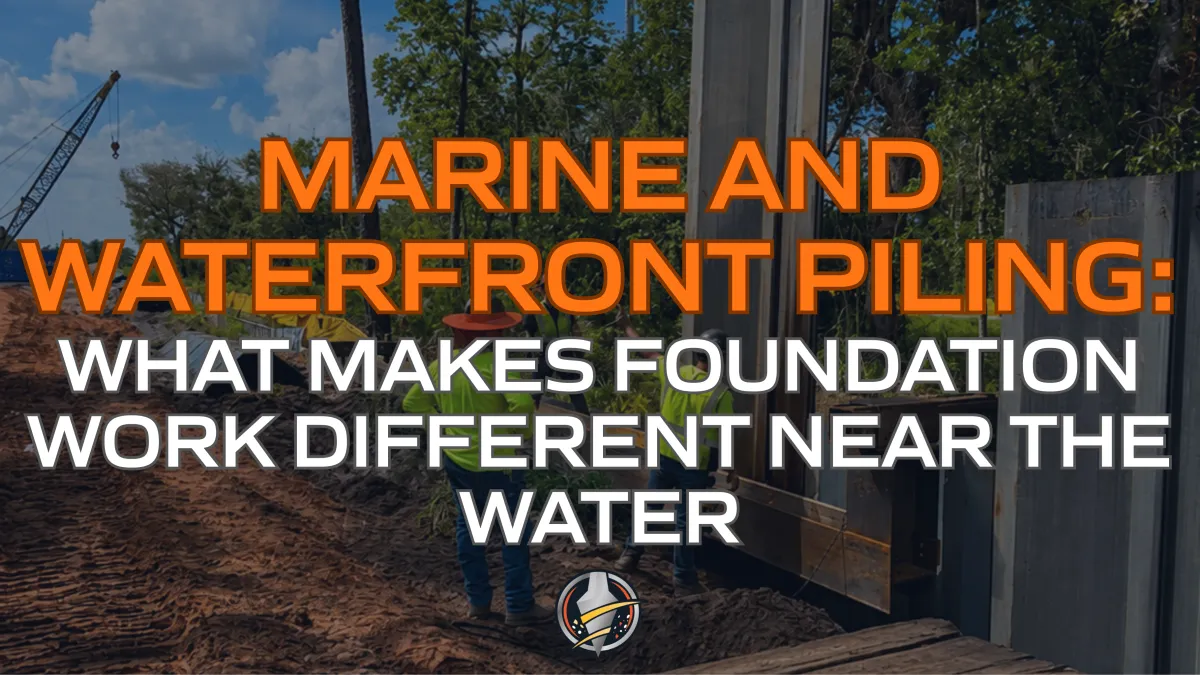
Marine and Waterfront Piling: What Makes Foundation Work Different Near the Water
Move a foundation project from dry land to a canal bank or a seawall, and three things change that have nothing to do with the structure itself: the soil sits underwater part of every day, the steel is exposed to salt instead of just moisture, and a permit from a state environmental agency joins the building permit as a requirement, not an afterthought. None of that shows up on a typical inland foundation job. All three show up here.
Seawalls and bulkheads, canal and waterway support, docks and piers, coastal residential and commercial development, flood and storm mitigation systems; Piling Pros groups these under marine and waterfront work because the engineering challenges overlap more than the finished structures suggest. A dock foundation and a bulkhead solve different problems, but both have to survive the same water.
Table of Contents
Marine and
Why Water Changes the Engineering, Not Just the View
Corrosion: The Problem That Never Takes a Day Off
What Falls Under "Marine and Waterfront" Work
The Permit Most People Don't See Coming
Terms Worth Knowing Before a Waterfront Proposal Lands on Your Desk
How Piling Pros Approaches Waterfront Projects
Why Water Changes the Engineering, Not Just the View
Soil that sits below a fluctuating water table behaves differently than soil that doesn't. As tides rise and fall, or a canal's water level shifts with rainfall and drainage cycles, the effective stress in the surrounding soil changes with it, and effective stress is a big part of what determines how much a pile or a wall can actually resist. A design based on a single groundwater reading, taken on a dry afternoon, can miss what that same soil does during a king tide or a wet-season high.
Wave action and current add a second load path that inland foundations never have to account for. A seawall doesn't just hold back soil the way an inland retaining wall does. It holds back soil that's actively being pushed and pulled by moving water, sometimes with real force behind it during storm events. Piling Pros treats Florida's soil variability as a starting assumption on every project, and waterfront sites take that variability and add a tidal or seasonal water table on top of it.
Corrosion: The Problem That Never Takes a Day Off
Steel in dry ground corrodes slowly, if at all, over a normal service life. Steel sitting in salt or brackish water corrodes continuously, and the rate accelerates in the splash zone, the band right around the waterline where wet-dry cycling and oxygen exposure combine to eat through unprotected steel faster than full submersion or full exposure would on their own.
This is exactly why marine-grade steel exists as its own material category rather than a coating applied after the fact. ASTM A690/A690M specifies steel piling formulated with added nickel, copper, and phosphorus specifically for atmospheric corrosion resistance in marine environments. It's a different alloy, not just a different paint job. Specify ordinary structural steel on a seawall because it's cheaper up front, and the corrosion allowance that should have been built into the design shows up years later as a section-loss problem nobody budgeted for.
What Falls Under "Marine and Waterfront" Work
Seawalls and bulkheads do the most visible job: holding a shoreline in place and stopping erosion from eating into the property behind it. Structurally, most are a sheet pile wall at their core, sized the same way any sheet pile wall gets sized for lateral pressure and driven to a depth that accounts for scour and water-side soil loss rather than the embedment math used on a dry excavation. USACE's manual for sheet pile wall design covers waterfront retaining structures specifically, not just the inland excavation case. Canal and waterway support solves a narrower version of the same problem, retaining soil along a waterway edge, often with less wave energy but similar tidal groundwater behavior.
Docks and piers ask a different question entirely, since they're usually deep foundation elements supporting a structure that sits partly or fully over water rather than a wall retaining soil behind it. Coastal development work, meaning the foundations under waterfront homes, condos, and commercial buildings, combines pieces of both problems, since these structures often need both vertical foundation support and some form of shoreline protection nearby. And flood and storm mitigation work ties the rest together, since a foundation or shoreline system engineered without storm loading in mind is a system that hasn't really accounted for where it's being built.
The Permit Most People Don't See Coming
Inland construction typically needs a building permit and calls it done. Waterfront construction in Florida usually needs that plus an Environmental Resource Permit through the Florida Department of Environmental Protection, since work along a shoreline, canal, or submerged land touches state-regulated water resources.
That permit isn't a rubber stamp, and it isn't fast. Timelines vary by project scope and jurisdiction, but the review considers things a building department never touches: impacts on water flow, marine habitat, and adjacent properties among them. Projects that treat this as a footnote to schedule around, rather than a real dependency to plan for, are the ones that end up with equipment mobilized and a crew standing around waiting on paperwork.
Terms Worth Knowing Before a Waterfront Proposal Lands on Your Desk
Effective stress is the portion of soil pressure actually carried by the soil grains themselves rather than by water in the pore spaces, it drops as the water table rises, which is exactly why tidal fluctuation matters so much to waterfront foundation design.
The splash zone is the section of a marine structure that alternates between wet and dry as water levels change, and it's typically where corrosion damage on unprotected steel shows up first and worst.
A corrosion allowance is extra material thickness designed into a steel section specifically to account for the section loss expected over its service life in a marine environment — not a safety margin against a mistake, but a planned-for cost of doing business in saltwater.
And an Environmental Resource Permit (ERP) is the state-level permit required for most construction affecting submerged lands, wetlands, or surface waters in Florida, separate from and in addition to local building permits.
How Piling Pros Approaches Waterfront Projects
Every waterfront site gets evaluated on its own tidal and groundwater behavior before a design gets locked in, not against a generic assumption about "coastal conditions" borrowed from a different project down the canal. Soil sampling, water level data across a tidal cycle where relevant, and the site's actual wave or current exposure all factor into material selection and structural sizing.
Permitting gets built into the project timeline from the start rather than treated as a parallel track that can be sorted out later. On sites where excavation has to happen below a fluctuating water table, dewatering gets planned alongside the structural design rather than figured out once equipment is already on site. And material choices (steel grade, coating systems, corrosion allowance) get sized to the specific exposure a site will see over its service life, not a one-size-fits-all spec pulled from the last waterfront job. The goal is a structure that's still doing its job in twenty years, not one that looked fine at the ribbon-cutting.
Mistakes That Turn a Waterfront Project Into a Costly One
Designing to a single groundwater reading instead of a tidal range. A water table measurement taken once, on one day, tells you almost nothing about what a site experiences across a full tidal or seasonal cycle.
Specifying standard structural steel to save money upfront. The savings disappear the first time a section-loss inspection comes back worse than expected, usually years before the structure was supposed to need attention.
Treating the environmental permit as a formality. It's a real regulatory review with its own timeline, and projects that don't plan around it end up with idle crews and slipped schedules waiting on paperwork that should have started months earlier.
Ignoring wave and current loading on a structure that looks like a simple retaining wall. A seawall isn't a landlocked retaining wall with wet soil behind it, it's a structure actively loaded by moving water, and designing it like the former misses real forces the latter has to resist.
Frequently Asked Questions
Do all waterfront projects in Florida need an environmental permit?
Most construction affecting a shoreline, canal, or submerged land does, through the state's Environmental Resource Permitting program. The specific requirements depend on project scope and location, so this gets confirmed early rather than assumed.
Why does marine steel cost more than standard structural steel?
It's a different alloy, formulated with added nickel, copper, and phosphorus specifically for corrosion resistance in salt and brackish water; the added cost buys service life the standard material doesn't have in that environment.
Can a seawall be repaired instead of replaced if it's showing corrosion damage?
Sometimes, depending on how much section loss has occurred and where, but by the time damage is visible above the waterline, there's often more happening below it than a visual inspection alone can confirm.
How is a dock foundation different from a seawall foundation?
A dock foundation is typically a deep foundation system supporting a structure over water, while a seawall is a retaining structure holding soil back; these are different structural problems that happen to share the same corrosive environment and tidal groundwater behavior.
What to Do Next
Waterfront projects carry engineering and permitting demands that inland construction simply doesn't have, and both need to be planned for from day one, not discovered halfway through. Send Piling Pros your site and project details and we'll evaluate what your specific shoreline, canal, or waterfront site actually requires.