
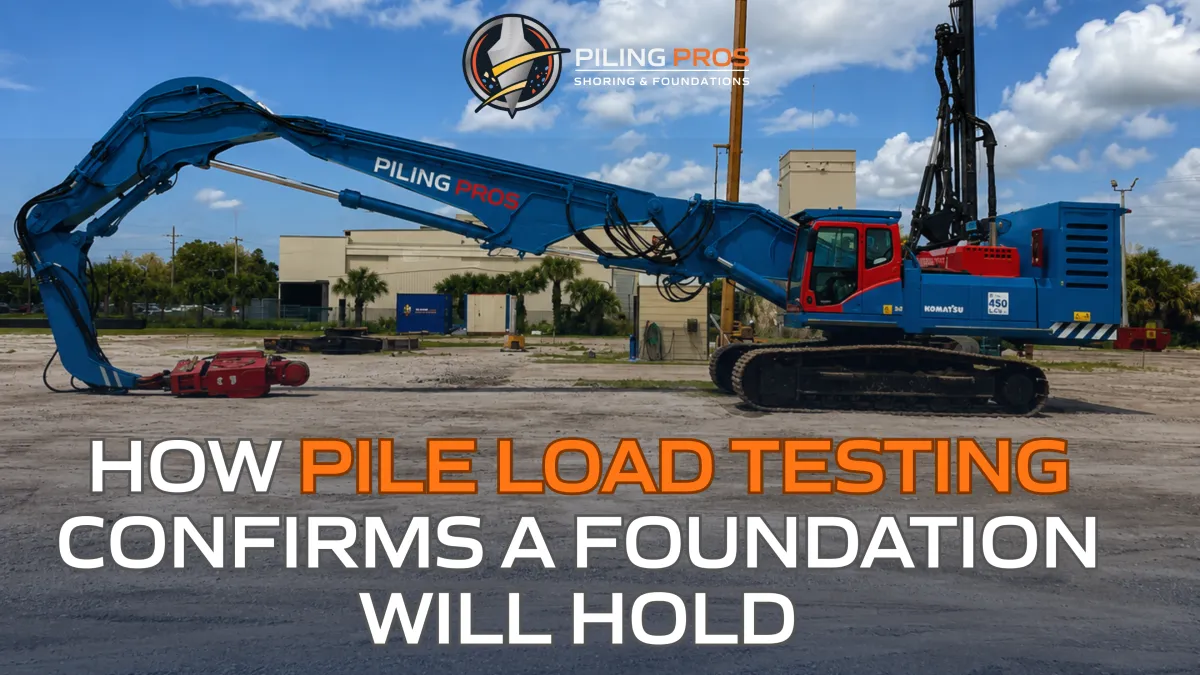
How Pile Load Testing Confirms a Foundation Will Hold
A design calculation says a pile will carry a certain load. Pile load testing is how you find out if that's actually true; a pile already in the ground gets pushed, pulled, or struck with real force so its measured capacity can be checked against the number the design assumed. Watching a pile go in and confirming it was installed correctly is not the same thing. One tells you the pile was built to spec. The other tells you what the pile can actually carry now that it's there.
Engineers ask this question when they're signing a design. GCs ask it before clearing a foundation for the next phase. Developers ask a version of it when they just want to know what "verified" is supposed to mean on their project. Same underlying question, three different reasons for asking, and the same honest answer applies to all of them: a design number is an estimate until a test backs it up. Piling Pros treats that confirmation as part of deep foundation work, not an extra line item, for the same reason pile type selection gets driven by site conditions instead of habit; skip the check and the risk doesn't disappear; it just resurfaces later, usually as the kind of planning mistake that turns into a change order.
Table of Contents
Why "It Should Hold" Isn't a Real Answer
What a Load Test Actually Measures
Static Load Testing vs. Dynamic (PDA) Testing
Terms Worth Knowing Before the Report Lands on Your Desk
What Gets Missed When Testing Gets Skipped or Rushed
How Piling Pros Verifies Capacity on Every Project
Why "It Should Hold" Isn't a Real Answer
A pile's design capacity comes from soil borings, an assumed soil strength, and a safety margin layered on top. Necessary math, but still a prediction. Borings only sample specific points across a site, not every cubic foot of ground under it, so the soil a pile actually lands on can behave a little differently than the report assumed. Sometimes a lot differently.
Two mix-ups cause most of the confusion here. First, people treat load testing as optional; something you can skip if the design already looks conservative. Second, they assume a visual inspection already covers it, since somebody watched the pile go in and it looked fine going down. Neither holds up. An inspection tells you the pile matches the drawings. A load test tells you the pile, once it's actually in the ground, carries what the design says it should. Different questions, and only one of them hands an engineer a number worth signing off on.
What a Load Test Actually Measures
A load test applies force to a pile; either a sustained physical load at the top, or an impact sent down through it, and reads how the pile responds. That response gets compared against the capacity the design is counting on.
It's not a pass/fail stamp. A test produces real data: how far the pile moves under a given load, how much of that movement is recoverable versus permanent, and the point where the pile stops gaining resistance no matter how much more load gets added. An engineer reads that data to confirm the assumed capacity is actually there, or to catch the fact that it isn't before anyone builds a structure on top of it.
Static Load Testing vs. Dynamic (PDA) Testing
Two main methods, used for different reasons.
A static load test applies a slow, sustained load directly to the pile using a hydraulic jack reacting against weighted platforms, anchor piles, or ground anchors, then tracks settlement as the load climbs. ASTM D1143/D1143M governs this method, and it's the most direct way to measure capacity there is. It's also the slowest and priciest, since it means building a full reaction frame on site and running the test over hours.
A dynamic load test, the PDA test, short for Pile Driving Analyzer, uses a large impact hammer blow instead, with strain gauges and accelerometers instrumenting the pile to capture how it responds in real time. That data gets run through the method in ASTM D4945, the standard for high-strain dynamic testing of piles. Faster, cheaper, and that's exactly why it gets used far more often, particularly on jobs with a large number of piles where testing every single one statically just isn't practical.
Neither one is automatically the right call. A handful of critical piles with tight tolerances might justify a static test on at least one of them. A larger group of similar piles usually leans on dynamic testing across a bigger sample, calibrated against a static test run on a smaller subset. FHWA's guidance on driven pile design walks through how that sampling decision typically gets made.
Terms Worth Knowing Before the Report Lands on Your Desk
Ultimate capacity is the maximum load a pile can carry before it stops developing any more resistance, no matter how hard you keep pushing. It's a theoretical ceiling. Nobody designs directly for it.
Allowable capacity, sometimes called design capacity, is what a pile is actually permitted to carry in service, ultimate capacity divided by a safety factor. This is the number on the foundation drawings.
Between those two sits the factor of safety, the margin meant to absorb uncertainty in soil conditions, construction variability, and load changes down the road. Most deep foundation work falls somewhere in the 2 to 3 range, though the exact figure depends on how much load testing actually got done.
Round out the vocabulary with a static load test (a slow, direct load test measuring settlement under sustained force, per ASTM D1143/D1143M) and a dynamic or PDA test (a high-strain impact test estimating capacity from instrumented measurements taken during a hammer blow, per ASTM D4945). Know those five terms and most load test reports stop reading like a foreign language.
What Gets Missed When Testing Gets Skipped or Rushed
Same handful of failure points, over and over.
Testing too few piles tops the list. A single test on a large pile group tells you about that one pile. It doesn't tell you about the group, especially on a site where soil quality shifts from one end to the other. Florida's soil profile can change enough across a single site that a boring taken a hundred feet away tells a genuinely different story than the one the design leaned on, which is the whole argument for a representative sample over a single data point.
Bad timing is next. Certain soils, clays especially, gain capacity over time as pore pressure from driving dissipates. Test too soon, and you can understate the real capacity, which can trigger a redesign nobody actually needed. Waiting out the proper setup period matters almost as much as running the test in the first place.
Groundwater gets underweighted more than anything else. A high water table changes effective stress in the surrounding soil, which changes how much resistance a pile can generate. Sites that need active dewatering during excavation are precisely the sites where capacity swings hardest depending on when a test runs; the water table on test day doesn't always match what the design assumed.
How Piling Pros Verifies Capacity on Every Project
A design capacity isn't treated as the final word here. Every deep foundation job gets its own testing plan, built around the actual soil profile, pile type, and load requirements for that specific site, not a flat percentage pulled from habit. That plan gets locked in before piles go in the ground, so the sequence, sample size, and timing are decided up front instead of improvised once something looks off.
The reasoning is straightforward, honestly: no two sites share the same soil, even sites sitting a few hundred feet apart. A design that worked on the last project is a useful starting point, not a guarantee for the next one. Treating every site like it needs its own verification, run by people who understand both the geotechnical side and the installation side, is what keeps a design number from turning into an assumption nobody actually checked.
Mistakes That Cost Time or Trust Here
Assuming a conservative design skips the need for testing. A wide safety margin on paper says nothing about whether the soil is actually behaving the way the report predicted. It just shrinks the consequences of being wrong.
Treating an inspection as a stand-in for a test. Watching a pile go in confirms installation quality, full stop. It says nothing about the load that pile can actually carry once it's sitting in the ground.
Running a test on a fixed calendar instead of the right one. Test a clay soil before it finishes regaining strength after driving, and you can get a capacity number lower than what the pile will eventually achieve, which sets off an unnecessary, expensive redesign.
Ignoring how much groundwater and soil vary across the site. One test result from one spot doesn't automatically carry over to a pile driven somewhere else on the same job once the soil or water table shifts.
Frequently Asked Questions
Is pile load testing required by code?
Depends on the project, the local building code, and the load requirements, but most commercial or structural deep foundation designs call for some level of testing, static, dynamic, or both, before the design capacity gets finalized.
How many piles actually need testing on a typical project?
No universal percentage exists here. A geotechnical engineer sets the sampling plan around how uniform the soil is, how many piles are going in, and how much risk the design can absorb.
What's the real difference between a static and a dynamic load test?
A static test applies a slow, sustained load and measures settlement directly, the more precise of the two. A dynamic (PDA) test uses an instrumented impact blow to estimate capacity, which is why it's faster, cheaper, and used far more often across larger pile groups.
Does load testing slow down the schedule?
It adds time. Usually a lot less time than discovering a capacity problem after the structure above the foundation already exists. Dynamic testing especially can often run alongside other site work instead of sitting on the critical path.
What to Do Next
Whether you're an engineer who needs a design number confirmed, a GC who needs sign-off before the next phase starts, or a developer trying to figure out what "verified" is even supposed to mean here, that conversation is worth having before piles go in the ground. Send Piling Pros your project details, and we'll build a testing plan around your actual soil, not a generic assumption about it.