
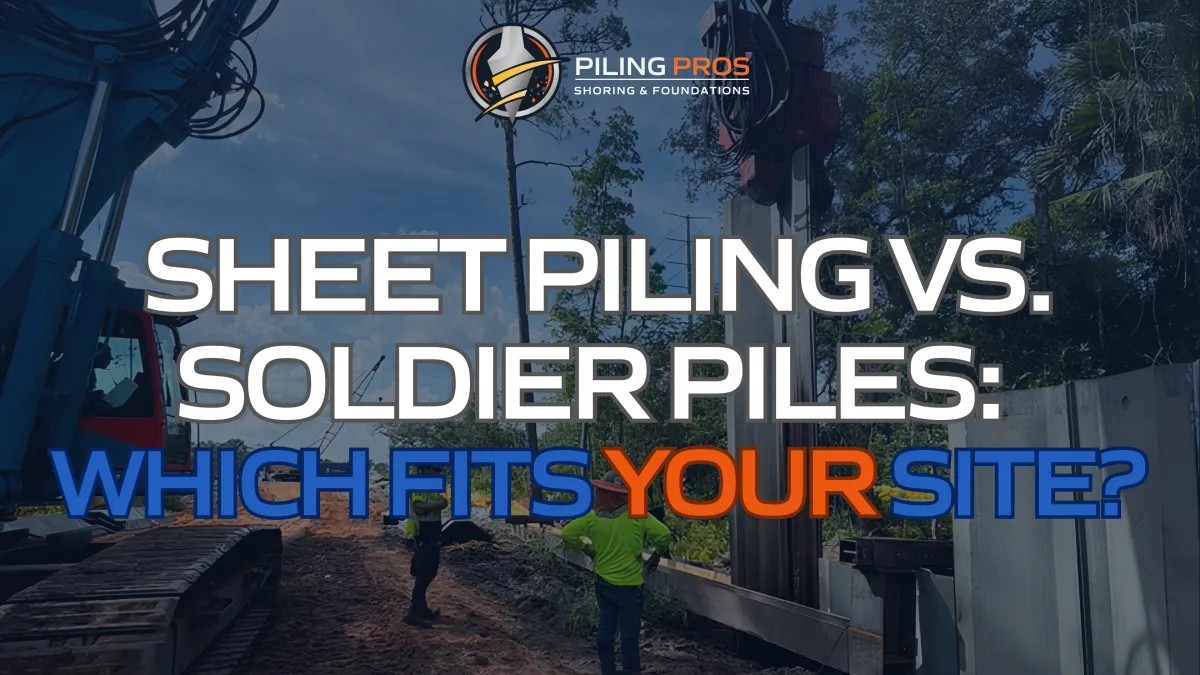
Sheet Piling vs. Soldier Piles: Which Fits Your Site?
Sheet piling and soldier piles both hold back soil during an excavation, but they're not interchangeable. Sheet piling uses continuous interlocking steel sections driven side by side, which makes it the better call on wet, sandy, or unstable ground where water needs to be kept out along with the soil. Soldier piles and lagging use spaced vertical posts with boards or panels between them, which usually costs less and installs faster on drier, more stable sites where a truly watertight wall isn't the point. The short version: if groundwater is the problem, lean sheet piling. If it's mostly about soil and budget, soldier piles usually win.
That's the quick answer. The real answer depends on your soil report, your site access, and what's sitting next to your excavation, which is exactly what the rest of this article gets into.
For a GC pricing a bid, an engineer of record stamping a shoring plan, or a developer trying to hold a schedule together, this isn't a minor spec choice. Picking the wrong system shows up later as a change order, a redesign, or a delay nobody budgeted for. We've built our shoring practice around catching that mismatch before it becomes a jobsite problem, which is the reason project teams bring us in during bid or design instead of after the excavation's already underway.
Table of Contents:
Why This Comparison Trips People Up
What Soldier Piles and Lagging Actually Are
The Real Differences That Matter On Site
Mistakes That Cost Time or Money Here
A Realistic Comparison Scenario
How Piling Pros Approaches the Decision
Why This Comparison Trips People Up
Most people researching this aren't asking out of curiosity. They've got a geotechnical report, a set of drawings, and a GC asking which system to price out, and the two options look similar enough on paper to cause real hesitation.
Both are excavation support systems. Both hold back soil so people can safely dig, pour, and build below grade. But they're built differently, they behave differently underground, and picking the wrong one doesn't just cost more, it can slow the whole schedule down or force a redesign mid-project.
Sheet piling and soldier piles and lagging are both part of the shoring toolbox we use regularly across South Florida, and we don't default to one over the other. The site decides.
What Sheet Piling Actually Is
Sheet piling is made from steel sections with interlocking edges. Each section connects to the next one, so once they're all driven into the ground, they form a continuous wall with no real gaps between panels.
That continuity is the whole point. A solid, interlocked wall does two jobs at once: it holds back the soil, and it resists water pushing through the same space. That's why sheet piling shows up so often on waterfront work, canal-adjacent lots, and any site where the water table sits close to the surface.
Steel is the material of choice here because it can take the stress of being driven into the ground without cracking, and sections can be welded or bolted together to extend a wall's length or height when a project calls for it.
What Soldier Piles and Lagging Actually Are
Soldier piles and lagging work differently. Vertical steel or concrete piles, the "soldiers," get installed at intervals, usually several feet apart rather than side by side. Horizontal boards or panels, the "lagging," get placed between those piles as the excavation goes down, section by section.
Because there's space between the piles, this system isn't watertight. It's built to hold back soil, not necessarily to keep groundwater out, which is exactly why it tends to show up on drier sites, or sites where dewatering is being handled separately.
It's also usually the faster, less expensive option to mobilize, since fewer linear feet of material are going into the ground compared to a continuous sheet pile wall covering the same excavation perimeter.
FHWA's own engineering circular on anchored wall systems draws this same line between the two. It describes soldier beam and lagging walls as spaced vertical elements built up in stages as excavation proceeds, while grouping sheet pile walls with other "continuous" systems that act as both a vertical and horizontal barrier, which is exactly why water pressure and watertight connections become a bigger design concern for sheet piling than for a spaced soldier pile system.
The Real Differences That Matter On Site
Cost and installation speed get most of the attention in these comparisons, but they're not actually the first thing we look at. Soil and groundwater are.
If the soil report shows soft, saturated, or sandy soil with a shallow water table, sheet piling tends to be the safer call, mainly because trying to dewater around a soldier pile and lagging system in that kind of ground gets complicated fast. Water finds the gaps between the lagging boards, and managing that mid-excavation is harder than designing it out from the start.
If the soil is firmer and drier, soldier piles and lagging can do the job for less money and less time on site, and there's often no real advantage to paying for a fully watertight wall you don't need.
Site access matters too. Sheet piling generally needs equipment capable of driving continuous sections, which can be a tighter fit on constrained urban lots. Soldier pile installation, drilling individual holes for each pile, can sometimes work in spaces a sheet pile rig can't.
And then there's what's next door. An occupied building, a sensitive utility line, or a property line a few feet from your excavation changes the calculation for both systems, since vibration, noise, and lateral movement tolerances all come into play.
Mistakes That Cost Time or Money Here
A few patterns show up often enough on this decision that they're worth calling out directly.
Picking based on price before the geotech report is final. Soldier piles and lagging often quote cheaper up front, but if the final soil report comes back wetter or looser than assumed, that price advantage can disappear fast once dewatering or a redesign gets added mid-project.
Assuming lagging can be "dewatered around" cheaply. It sometimes can, on a shallow, short-duration excavation. On a longer or deeper one, fighting water through gaps in a lagging system for weeks tends to cost more than just building a watertight wall in the first place.
Ignoring what's next door until later. An adjacent structure's foundation, a buried utility line, or a tight property line can rule out one system's installation method entirely, and that's a bad thing to discover after a system has already been priced and scheduled.
Locking in a system before the geotechnical report is finished. This is the one we push back on the most. A verbal description of the soil isn't the same as boring logs and groundwater readings, and a decision made without them is a guess, even when it turns out right.
A Realistic Comparison Scenario
Picture two projects on opposite sides of the same city.
The first is a basement excavation for a commercial building three blocks from the water, with a geotechnical report showing loose sand and a water table just eight feet down. Sheet piling is the likely answer here, since the water alone would make a lagging system a maintenance headache throughout construction.
The second is a parking structure excavation inland, on firm, well-drained soil, with no groundwater concerns in the report. Soldier piles and lagging probably get the job done here for less than a continuous sheet pile wall would cost, without giving up any real performance the project actually needs.
Same general task, retain the soil, protect the excavation, keep the schedule intact, but two different answers because two different sites.
How Piling Pros Approaches the Decision
We don't start this conversation by asking which system a client prefers. We start with the geotechnical report, the site access, the water table, and what's built nearby, then match the system to what that information actually says. Internally, that's a four-step process: review the site and plans, recommend the system that fits, mobilize the crew and equipment, and stay in communication with the GC and engineer through completion, instead of disappearing between "design" and "install."
That last part matters more than it sounds. A lot of shoring decisions get made by a designer who isn't the one driving the piles, and an installer who isn't the one who ran the calculation. When something doesn't line up in the field, that gap is where change orders and delays come from. Our engineering team includes a licensed PE focused specifically on shoring design, and the same company that runs that calculation is the one on site with the equipment, which closes that gap instead of leaving a GC to manage it between two vendors.
That PE sign-off isn't just good practice either. OSHA's excavation standard requires any protective system outside of standard tabulated designs to be engineered by a registered professional engineer, which applies to sheet piling and soldier pile systems alike once a project moves past the simplest, shallowest excavations. The standard is here if you want to see how it's written.
For an engineer of record, that means a contractor who can execute the design intent and flag a constructability problem before it becomes an RFI. For a GC or developer, it means one point of contact carrying the risk on this decision, not a designer pointing at an installer and an installer pointing back.
If you want a broader look at how that evaluation process works across every pile and shoring system we offer, not just these two, how engineers select the right pile system for a construction project walks through the full decision framework.
Why Project Teams Bring Us in Before the Bid Is Final
The teams that get the most value out of this aren't calling after the excavation has already started. GCs pricing a job, developers scoping a site, and engineers still finalizing a shoring plan bring us in during value engineering, while there's still room to compare sheet piling against soldier piles and lagging on cost and schedule, not just after one system's already been assumed in the drawings.
That timing is what turns this from a reactive decision into a planned one. It's also usually the difference between a shoring cost that's a known number in the bid and one that shows up later as a surprise.
Frequently Asked Questions
Can sheet piling and soldier piles be used together on the same site?
Yes, on larger or more complex sites, it's fairly common to use sheet piling where groundwater is a concern and soldier piles and lagging on drier portions of the same excavation, as long as the transition between systems is engineered properly.
Which system is cheaper, sheet piling or soldier piles?
Soldier piles and lagging are usually less expensive to install on sites that don't need a watertight wall. That advantage disappears quickly if groundwater forces extra dewatering costs partway through the project.
Does soil type alone decide which system to use?
No. Soil type is the starting point, but groundwater level, site access, excavation depth, and what's built next to the site all factor into the final recommendation.
Is sheet piling always the safer choice near water?
It's generally the more reliable choice for keeping water out of an excavation, but "safer" also depends on installation vibration, soil disturbance, and how close the work is to existing structures, which is why this still needs a site-specific evaluation.
What to Do Next
If you're a GC staring at a geotechnical report before a bid is due, an engineer trying to pressure-test a shoring assumption, or a developer trying to keep a schedule intact, that's a conversation worth having now, not after mobilization. Send Piling Pros your plans and geotechnical report and we'll tell you which system actually fits your site, back it with a licensed PE's design, and put the same team on the ground to install it.