
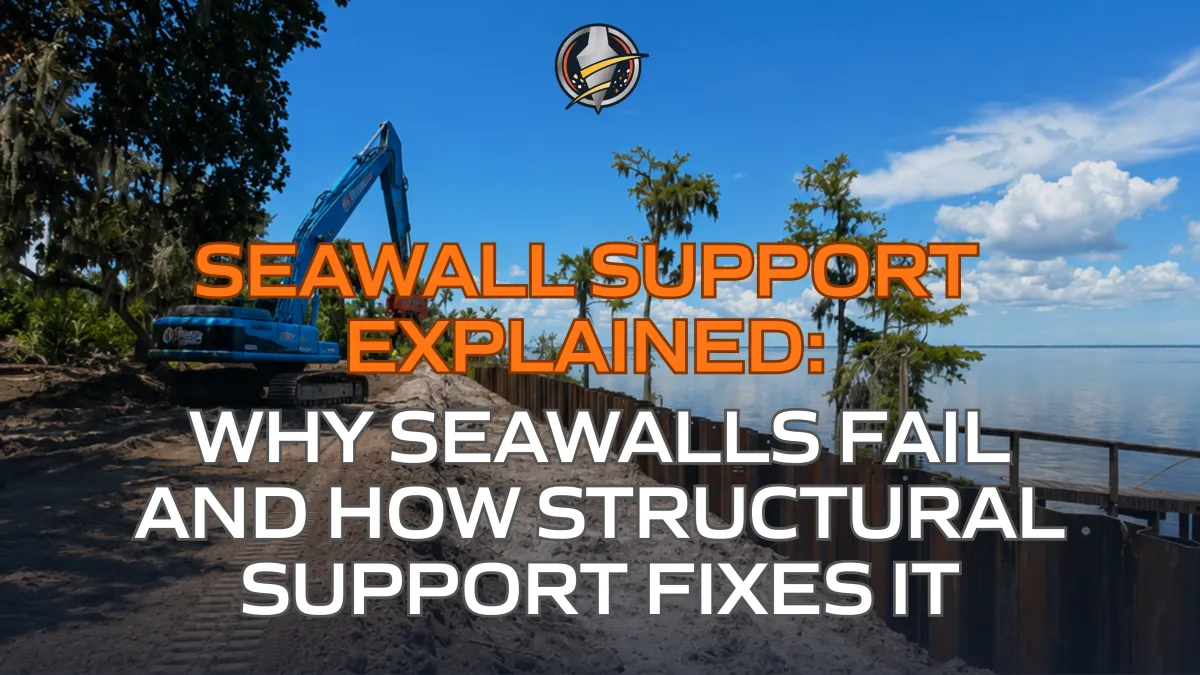
Seawall Support Explained: Why Seawalls Fail and How Structural Support Fixes It
Seawall support is the engineering and construction work that reinforces an existing seawall, or adds new structural elements behind and beneath it, to stop soil loss, correct movement, and restore the wall's ability to hold back water and soil pressure. It's a repair strategy, not a replacement. The original wall generally stays in place while new piles, tiebacks, or anchoring systems pick up loads the wall can no longer carry safely on its own.
Most property owners find out they need it the same way: a section of yard near the water starts sinking, a crack shows up in the cap, or the wall itself develops a visible lean. By the time any of that is visible from the surface, the actual problem has usually been developing behind the wall for a while. Piling Pros designs and installs seawall support systems as part of its broader marine and waterfront work across South Florida's canals, waterfront lots, and commercial marine sites, where soft soils and regular storm activity make this kind of failure fairly routine rather than rare.
Table of Contents
How a Seawall Actually Fails, Even When It Looks Fine From Above
A seawall's job is simple to describe and hard to keep working over time: hold back the soil and water pressure on the land side while the water side does whatever tides, storms, and boat traffic put it through. Most failures start with the soil behind the wall, not the wall itself. Water moving through gaps in the panels, or seeping under the toe of the wall, slowly carries fine soil particles out with it. That process, called erosion or soil migration depending on where it's happening, leaves a void behind the wall that nobody can see from the yard side until the ground above it finally sinks in.
Once that void gets big enough, the wall loses the soil support it depends on to resist the water pushing against it from the other side. A cap that cracks, a wall that starts to lean, or a section that bulges outward are all downstream symptoms of that same underlying process, just showing up at different stages. Working near the water changes the diagnosis in ways that surprise people used to ordinary foundation work on dry land; a seawall can look structurally sound on the surface for years after the real problem started.
What Puts Extra Pressure on South Florida Seawalls Specifically
Tidal fluctuation runs this cycle every single day, pushing soil moisture back and forth through the wall and the soil behind it, which accelerates whatever erosion pathway already exists. Storm surge and heavy rain events push both the frequency and the force of that cycle well past normal, saturating soil that's already compromised and adding load the wall wasn't necessarily designed to handle in a single event.
Boat wake matters more than a lot of property owners expect, especially on narrower canals where wake reflects off both sides. Every pass compounds the erosion that tidal movement is already causing, quietly, well below the waterline where nobody's watching it happen.
Rising groundwater and long-term water table shifts add a slower kind of pressure. A wall designed decades ago for a given water table can end up working against conditions that have shifted meaningfully since, which is one of the reasons older seawalls throughout the region are reaching the point of needing support work around the same general timeframe, even when they weren't all built at once.
Seawall Support vs. Full Seawall Replacement
Support and replacement solve different problems, and mixing them up leads to either overpaying for a full rebuild or underfixing a wall that's actually past the point support can help.
Support work adds new piles, tiebacks, or anchoring systems to reinforce a wall that's still structurally intact but losing the soil support behind it, the same underlying logic behind underpinning an existing foundation rather than replacing it outright. The existing panels stay in place, which keeps cost and disruption well below what a full teardown and rebuild would require. Replacement becomes the answer when the wall itself has failed structurally, whether that's severe panel cracking, a lean beyond what reinforcement can correct, or corrosion that's compromised the wall material to the point that adding support to it wouldn't hold. An engineer generally has to inspect the actual wall condition to know which category a given project falls into, since the visible symptoms alone can look similar from either cause.
Terms Worth Knowing Before a Seawall Proposal Lands on Your Desk
A tieback anchor is a rod or cable that connects the top of the seawall back to an anchoring point on the land side, transferring load away from the wall panel itself and into soil or a structure that can actually resist it. When people talk about reinforcing a seawall, this is often the specific mechanism they mean.
The anchoring point at the far end of that tieback is called a deadman, a buried block or plate that resists the pull of the tieback by relying on the soil packed around it. An old or undersized deadman is a common, and often invisible, reason a seawall that "should" be adequately anchored still moves.
Scour describes the localized erosion that happens right at the base of a structure, in this case the toe of the seawall, where water movement is often most concentrated. Scour at the toe undermines the wall's foundation even when the soil further back stays intact, which is why an inspection needs to check the base specifically rather than just the visible face.
And weep holes, the small drainage openings built into most seawall panels, exist to relieve water pressure from behind the wall. Blocked or undersized weep holes let pressure build up that the wall wasn't designed to resist continuously, which is a smaller detail than it sounds like on paper.
Where Seawall Support Isn't the Right Answer
A cracked cap or a slightly uneven yard near the water doesn't automatically mean a support project. Sometimes it's cosmetic, and sometimes it's the first visible sign of something that needs watching rather than immediate structural work.
Walls with advanced structural failure, meaning the panel material itself has degraded past the point reinforcement can compensate for, usually need replacement instead, since adding support to a wall that can no longer hold its own shape doesn't solve the underlying problem. Jurisdictional and permitting complications can also change the timeline and scope significantly; seawall work almost always requires review from state or local regulators before construction starts, and skipping that step isn't an option regardless of how urgent the repair feels. Local building departments publish their own seawall requirements on top of state review, and the two don't always move on the same schedule. And very minor cosmetic issues with no measurable movement often just need documented monitoring for a season or two before anyone commits to a repair scope.
How Piling Pros Approaches Seawall Support Projects
Every seawall project starts with figuring out what's actually happening below the waterline and behind the panel, not just what's visible from the yard.
Soil conditions, tidal behavior, existing anchor condition, and the extent of any voids behind the wall all get assessed before a support method gets chosen.
That assessment drives which reinforcement approach makes sense: new tiebacks and anchors where the existing system has simply aged out, additional piling where soil support has been lost more broadly, or a combination where multiple failure modes are happening at once. Coordinating with the permitting requirements that come with any waterfront work, including South Florida's environmental resource permitting process, gets built into the project timeline from the start rather than treated as a delay to work around later.
Mistakes That Turn a Minor Seawall Issue Into a Major One
Treating a small sinkhole near the wall as a landscaping problem instead of a seawall symptom probably causes more expensive repairs than any other single mistake on this list. That depression is very often the visible tip of a void that's already been growing for a while, out of sight.
"Waiting through a full storm season to see if it gets worse" costs plenty of property owners too. Soil loss behind a seawall doesn't pause between storms, and a wall that was marginal going into hurricane season can be in a very different condition coming out of it.
Skipping the geotechnical and structural assessment because the visible damage looks minor causes its own problems, since a wall that shows a small crack on the surface can still have significant void space or anchor failure behind it that a visual inspection alone won't catch.
Assuming a neighbor's seawall repair means the same solution applies next door is another one worth naming. Soil conditions, wall age, and anchor systems can vary meaningfully between adjacent properties, even along the same stretch of canal.
Frequently Asked Questions
How do I know if my seawall needs support work or just monitoring?
A visible crack that isn't changing, with no sinking ground nearby, often just needs periodic monitoring. A depression forming near the wall, a new lean, or a crack that's actively widening are stronger signals that it's time for an actual assessment rather than a wait-and-see approach.
How long does seawall support work usually take?
It depends heavily on the extent of the void behind the wall and the permitting timeline, which is frequently the longer of the two. The construction itself, once permits are in place, is often faster than property owners expect.
Does homeowners insurance typically cover seawall repair?
That varies by policy and by the cause of the damage, and it's a question for an insurance professional rather than a piling contractor to answer definitively. What Piling Pros can provide is documentation of the actual structural cause, which insurers generally need regardless of the outcome.
Can a seawall be reinforced without a full replacement?
In most cases where the wall panels themselves are still structurally sound, yes. Tiebacks, anchors, and additional piling can restore the support the wall lost without tearing out and rebuilding the whole structure, which is the scenario support work exists to address.
What to Do Next
A seawall that's showing any sign of movement, from a new crack to a soft spot in the yard nearby, is worth a real assessment before the next storm season makes the decision more urgent and more expensive. Send Piling Pros your project details and we'll evaluate what's actually happening behind the wall and what it will take to fix it.