
My Neighbor Is Digging a Big Hole: What It Can Mean for Your Building
Say it's a Tuesday morning and your property manager calls. A tenant says the glass in the lobby door is buzzing, and somebody spotted a crack in the stairwell that nobody remembers. You walk outside and look next door. Last month that was a parking lot. Now there's a fence with a banner on it, a rig, and a hole that gets deeper every day.
Is the dig to blame? Maybe. Maybe not. Nobody can tell you yet, and that's what this post is about.
We're Piling Pros. We do shoring and foundation work around South Florida, so most days we're the ones on the side of the fence with the hole. This is a note for the other side: what a nearby dig can do to a building, what you can ask for, and what to write down now so you aren't guessing later.
Table of Contents
What to ask for before the work starts
How to tell new damage from old
Terms Worth Knowing Before a Monitoring Plan Lands on Your Desk
When it's probably not the dig
What a dig next door can do
Think of the ground as part of what's holding your building up. Dig a deep hole beside it and you've removed some of that support. If nothing replaces it, the soil can slump toward the hole and your foundation can follow. We wrote about this in our post on how shoring protects adjacent structures: excavation can move nearby soil and reach neighboring foundations, utilities and roads, and Florida's variable soils and high groundwater make it harder.
Then there's the water. A lot of digs here have to pump groundwater out to stay dry, and pulling water out of the ground changes how the ground behaves. Dewatering planning has the longer story.
And vibration. Pile driving, sheet piling and soil compaction all shake the ground. The American Bar Association's construction group published a useful piece on damage from adjacent construction. Its take: structural damage from vibration is rare, but cosmetic cracks in brittle finishes get alleged all the time. The other cause it names is settlement from excavation and dewatering, and settlement is what leaves step cracks, racked doors and windows, and sloping floors.
Florida's DOT treats the risk as real too. A 2015 FDOT bulletin says existing structures on private property near construction have been affected by vibratory compaction, pile driving, excavation and dewatering. It's written for state road projects, so it's no rulebook for yours. It does show a state agency thinks the problem is worth putting on paper.
What owners notice first
Nobody watches soil move. You watch doors, walls and floors misbehave. Here's the usual list.
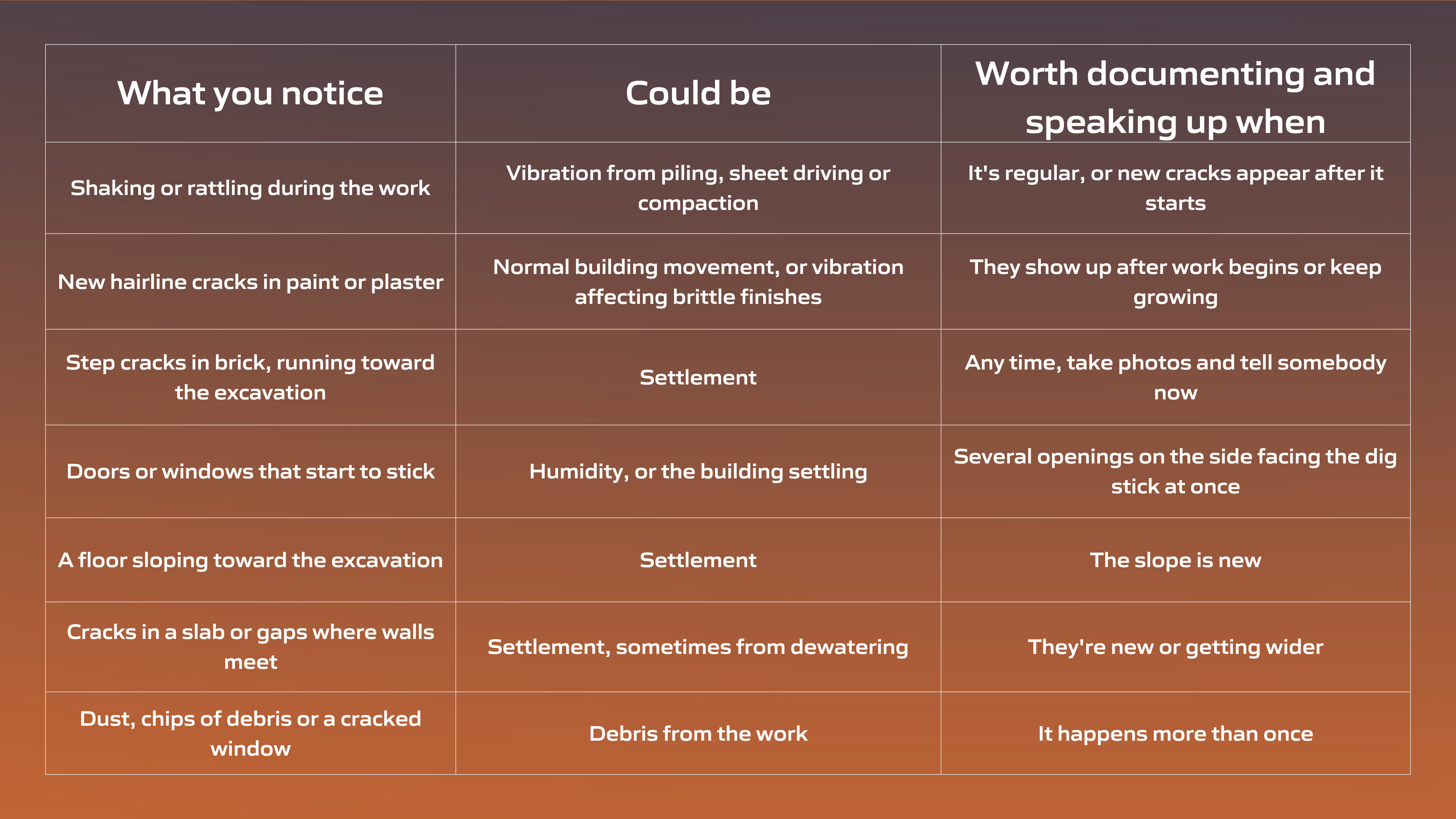
The ABA piece singles out two patterns: step cracks running perpendicular to an excavation along a property line, and floors that slope toward the excavation. Those point more strongly to construction-related movement. One sticky door? That's a weaker clue.
What to ask for before the work starts
If you hear about the dig early, you have your best shot at a baseline, meaning a record of what your building looks like before anyone starts. The ABA article says many jurisdictions require pre-construction surveys when soil or foundation work is planned, and that dated photos and measurements often prove decisive later. A good survey records levelness, plumbness, and where the cracks are and how big. The article doesn't cover Florida, so call your city or county building department and ask what applies to you.
Next, put a few questions to the team doing the work.
Is there monitoring, and what kind? The ABA piece lists optical surveys, crack gauges (people call them telltales) and vibration monitoring. Ask who watches the numbers and who you call if something looks off. We show what that looks like on our own jobs in instrumentation and monitoring: vibration sensors on neighboring foundations, and trigger levels that call for action before there's a problem.
What's holding the hole up? Sheet piling, soil anchors and braced excavations all do it differently. Sheet piling versus soldier piles and soil anchors and tiebacks walk through the differences.
When's the loud part, and what are the hours? In FDOT's bulletin, residences are on the list of sensitive sites, where a project note can set stricter limits, restrict hours or restrict the type of equipment.
Sometimes a developer offers a written agreement. The ABA article says these typically cover access to your property, debris protection, indemnification, insurance, compensation for disruption, notification thresholds and work hours. Get a lawyer to read it before you sign. We build foundations. We don't practice law.
How to tell new damage from old
Every building has cracks. Nobody looks at them until a hole opens next door. So the real question, as the ABA article puts it, is whether a condition is new or just newly noticed. Old cracks and out-of-plumb walls are common, especially in older buildings.
The article gives some signs of a recent crack: crisp edges, no debris or paint inside it, and finishes like countertops, door frames and baseboards still sitting level against the floors and walls. If the edges are dirty and rounded and there's old paint in there, it's probably been around a while.
That's why dated photos from before the work are so valuable. No photos yet? Start today. Pencil a mark at each end of the crack, write the date next to it, and check back in a week or two. Snap a quick picture every week. It takes a minute.
Terms Worth Knowing Before a Monitoring Plan Lands on Your Desk
A few words you'll hear once monitoring comes up. A pre-construction survey, which some people call a condition survey, is a documented look at your building before work starts. Telltales are small gauges across a crack that show whether it's opening. Settlement is sinking, plain and simple, and when one part sinks more than another, that's differential settlement.
Then the vibration vocabulary. Peak particle velocity is a way to measure how hard the ground shakes, and a vibration limit is the number everybody agrees not to cross. We won't give you one. The right number depends on the building and the site, and the sources we read were describing limits for their own settings, not yours. A trigger level, or alert level, is a reading that sets off a response, like a closer look or a change in how the work is done.
Two more. Dewatering is pumping groundwater out to keep the hole dry, and a shoring system is whatever holds up the sides of the hole, whether that's sheet piling, soil anchors or internal bracing.
When it's probably not the dig
Be fair to the dig. Plenty of cracks have nothing to do with it. Hairline cracks in paint and plaster show up in healthy buildings. A door that sticks all summer and frees up in the dry months is usually just wood. A floor that was never perfectly level doesn't turn into a defect because an excavator showed up.
What matters is timing and pattern. A crack that appeared after the work began, on the wall facing the hole, and keeps growing? Pay attention. A hairline that's been there for years? Probably not the dig. If you can't tell, get your own engineer or surveyor to look, not only the team doing the digging.
How Piling Pros approaches protecting neighboring buildings
On our side of the fence, the neighbors go into the plan on day one. We start with the drawings, the soil and geotechnical data, groundwater, access and everything else about the site, including the building next door. Our support of excavation page describes this work as stabilizing soil, managing lateral pressure and protecting surrounding structures during deep or complex excavations.
Then we pick a system that fits the soil, the loads and the site, and we run a constructability review to test the plan before anyone mobilizes. If noise and vibration matter, there's a press-in method we use for sheet piling. Our post on whether piling will disturb your neighbors describes it as producing much less vibration and noise than impact or vibratory driving. We'd consider it for sensitive sites, and we wouldn't force it on every project. Monitoring gets planned alongside the construction, so readings are compared against a baseline and nobody's guessing afterward.
Mistakes
Waiting for a crack before taking your first photo is the classic. No before picture, no way to say what's new.
Blaming the dig for every crack comes next. Some were there already, and a record that separates old from new makes your case stronger.
Staying quiet. If you see something, tell the project team in writing, with photos, while the crew is still on site. It's much easier to fix a problem that's still happening.
Patching a crack and moving on erases the evidence. Photograph it first and mark the ends.
And signing an agreement nobody has read. Access, insurance, indemnification: that's lawyer territory.
Frequently Asked Questions
Can digging next door damage my building?
It can. The ABA article lists settlement from excavation and dewatering as a cause of damage to adjacent buildings, and FDOT says existing structures on private property near construction have been affected. How much movement you get depends a lot on how the hole is supported and monitored. A good plan aims to keep it small.
What should I ask the developer for before work starts?
A documented survey of your building, the monitoring plan, a contact person and the work hours. Got an agreement? Have a lawyer read it first.
Will vibration crack my walls?
Cosmetic cracks in brittle finishes get alleged a lot, says the ABA article, while structural damage from vibration is rare. What happens at your building depends on the equipment, the distance and the building itself, and that's one reason monitoring helps.
How do I tell new cracks from old ones?
Dated photos from before the work. Without them, the ABA article suggests checking for crisp edges, no debris or paint in the crack, and finishes that sit level against floors and walls.
Who's responsible if my building gets damaged?
That depends on where you are, the permits and contracts involved, and what evidence you have. The ABA article says the legal consequences vary by jurisdiction and offers no Florida answer. We're not lawyers, so call an attorney and your insurer.
What to Do Next
Planning an excavation next to occupied buildings?Send Piling Pros your project details and we'll tell you what we'd check first.