
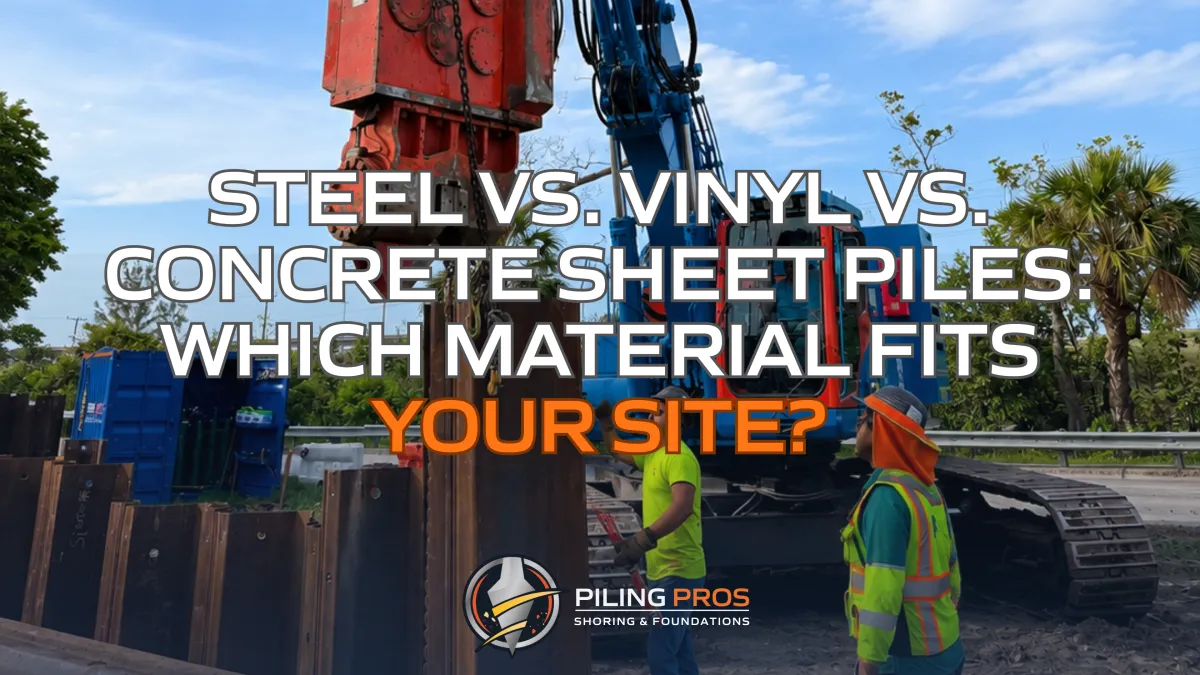
Steel vs. Vinyl vs. Concrete Sheet Piles: Which Material Fits Your Site?
Steel, vinyl, and concrete sheet piles are not three price points on the same product. They're three different materials with three different strength profiles, corrosion behaviors, and installation demands, and the right one comes out of the site itself: how corrosive the soil or groundwater is, how deep the wall needs to go, what loads it has to carry, and how long it needs to perform without maintenance. Pick based on cost per linear foot alone, and the "savings" usually show back up a few years later as a repair bill.
That's the real answer. What follows is what actually separates the three materials, where each earns its place, and the mistakes that turn a material decision into an expensive one. If you're already working through how deep a wall needs to go or how much lateral support it has to provide, material selection runs alongside those calculations, not after them; the material affects both. And if you haven't settled on sheet piling as the system yet, that comparison against soldier piles is a separate question from the one this article is answering.
Table of Contents
Why "Cheaper" and "Interchangeable" Are Different Questions
Terms Worth Knowing Before You Compare Quotes
How Piling Pros Chooses the Right Material
Why "Cheaper" and "Interchangeable" Are Different Questions
The most common mistake in this whole comparison is treating three different products as one product at three price tiers. Each material carries a different strength-to-weight ratio, handles corrosion its own way, and installs through a completely different process. What's "right" depends entirely on what the site is actually asking the wall to do.
A permanent wall driven into corrosive, waterlogged soil has almost nothing in common with a temporary wall holding back a short excavation on dry, stable ground. Compare materials without comparing them against real site conditions first, and you can end up with a wall that came in on budget and then needed an expensive intervention a few years down the line.
Steel Sheet Piles
Steel is the workhorse of the three. It has the best strength-to-weight ratio of the group, which lets it span taller walls and carry higher lateral loads without needing an oversized section. It drives through dense or obstructed soils better than the alternatives, and interlocking steel sections can be cut, welded, or extended on site when field conditions call for it.
Corrosion is the catch. Steel sitting in moisture; marine or brackish groundwater especially loses section thickness over time unless something protects it. USACE's design manual for sheet pile walls builds this directly: a structural design has to plan for material loss over the wall's service life, not just how it looks on install day. That usually means a corrosion allowance baked into the section thickness, a protective coating, cathodic protection, or some mix of the three depending on how aggressive the exposure is and how long the wall has to last. It's also the material Piling Pros' sheet piling work centers on, since it covers the widest range of load and depth requirements across the excavation support jobs the company runs most.
Vinyl Sheet Piles
Vinyl, or PVC, sidesteps the corrosion problem entirely; it doesn't rust or degrade the way steel does in wet or chemically aggressive soil. That makes it a solid fit for lighter-duty retaining walls, residential waterfront jobs, and anywhere long-term corrosion resistance outweighs the need for raw load capacity.
The tradeoff runs opposite to steel. Vinyl's strength-to-weight ratio caps how much lateral load it can carry and how deep or tall a wall it can support before steel or concrete becomes the more sensible choice. It also responds to temperature swings differently than steel, part of why the material now has its own dedicated spec, ASTM D8427, covering material and testing requirements written specifically for vinyl rather than borrowed from steel piling standards.
Concrete Sheet Piles
Precast, prestressed concrete sits at a different point on the durability curve entirely. It resists corrosion and marine growth better than unprotected steel, and once cured, holds up in exactly the kind of long-term marine and waterfront exposure covered under Piling Pros' marine and waterfront work, the kind of environment where a wall needs to perform for decades with almost no maintenance.
Weight and handling are the price you pay. Concrete sections are heavier and more brittle to install than steel or vinyl, so driving tolerances matter more, and a section that gets damaged or misaligned during installation is much harder to fix in the field. The Precast/Prestressed Concrete Institute's design guidance for sheet piling covers the structural design considerations specific to precast sections, considerations that look nothing like the steel-focused design methods used for driven steel walls.
Terms Worth Knowing Before You Compare Quotes
The interlocking joint is what connects adjacent sheet pile sections into a continuous wall, and joint design shifts by material: steel usually runs a rolled or welded interlock, vinyl uses a molded interlock built for watertightness, and concrete uses a formed joint often paired with a waterstop.
Corrosion allowance refers to extra thickness added to a steel design specifically to cover the section loss expected over the wall's service life, so it still meets its structural requirement years after installation, not just on day one.
And driveability; how practically a section can go into the specific soil at a given site without damage, refusal, or excessive vibration, comes down to material stiffness, section weight, and soil density together. Same wall design, same specs, and it can be a straightforward install in one soil profile and a real fight in another.
How Piling Pros Chooses the Right Material
The conversation doesn't start with a price list. It starts with the soil report, the groundwater conditions, the structure's required service life, and the actual loads the wall has to carry, because those factors decide which material is structurally and economically appropriate before cost enters the picture at all.
That review is also where sites that look straightforward on paper get flagged before a mistake gets built into the wall: corrosive groundwater that would eat through an underspecified steel section, a load requirement that would push past what vinyl can handle, a marine environment where concrete's long-term durability outweighs what it costs to install. All of that surfaces during the review, before the material's already been ordered.
None of this is about steering a project toward whichever material happens to be easiest to source. It's about making sure the wall lasts as long as the structure behind it needs, at a cost that actually reflects the site rather than a generic assumption about it. That's the line between a recommendation and a guess.
Mistakes That Turn a Material Choice Into a Costly One
Treating the three materials as interchangeable. Steel, vinyl, and concrete carry loads, resist corrosion, and install in completely different ways. Swap one for another without re-running the design, and the wall underperforms.
Skipping the ground conditions check before picking a material. Corrosivity, groundwater chemistry, and soil density all drive which material actually makes sense here. Pick before that data exists, and you're guessing, not deciding.
Chasing the cheapest material without weighing service life. Lower upfront cost on a material that corrodes, cracks, or underperforms for the site tends to show back up later as a repair, a reinforcement, or a full replacement, all of which cost more than getting it right the first time.
Skipping professional input entirely. Material selection sits right at the intersection of structural engineering and site-specific geotechnical conditions. That's not a decision to make off a spec sheet alone.
Frequently Asked Questions
Is steel always the strongest choice for a sheet pile wall?
Steel typically has the best strength-to-weight ratio of the three, which is why it shows up on taller walls and higher-load jobs. But "strongest" and "right for this site" aren't the same thing once corrosion exposure or budget constraints point somewhere else.
Can vinyl sheet piles handle a permanent structure?
Yes, within its load limits. It performs well on lighter-duty and residential waterfront work where corrosion resistance matters more than high lateral load capacity, but it's not a stand-in for steel or concrete on taller, heavily loaded walls.
Why would someone choose concrete over steel for a marine wall?
Because concrete outlasts unprotected steel in corrosion and marine growth resistance over a long service life, which can make it the more economical pick for a permanent waterfront structure even with a higher install cost.
Does the cheapest material end up being the cheapest project?
Usually not. A material that doesn't fit the site's soil or groundwater conditions tends to need repair or replacement sooner than one specified the first time correctly, and that costs more over the life of the structure.
What to Do Next
If you're specifying a wall or pricing one out, get the material decision reviewed by someone who does this before it's locked in, not after the order's already placed. Send Piling Pros your site and soil details, and we'll match the material to what the project actually needs.