
Value Engineering Without Cutting Corners: What's Fair Game and What Isn't
Picture the meeting. The bids are in, the number is higher than anybody hoped, and somebody leans back and says, "Let's value engineer it." Everyone nods. Ten minutes later half the table is talking about cheaper piles and the other half is talking about a smarter way to build the same thing, and nobody has noticed they're having two different conversations.
On a foundation job those two conversations end up in very different places. Some things can change without hurting anything, like the order the crews work in, the rig that shows up, or where the trucks park. Other things can't change, because the building leans on them for as long as it stands. This post is about where that line sits and who gets to move it.
Piling Pros does value engineering on shoring and foundation work around South Florida. If you'd rather start with why it pays to do it early, our older post on how value engineering supports better decisions covers that side.
Table of Contents
What value engineering means (and doesn't)
What can change and who has to say yes
Why South Florida sites make the question harder
Terms Worth Knowing Before a Value Engineering Proposal Lands on Your Desk
When value engineering isn't the answer
What value engineering means (and doesn't)
The formal version is longer than you'd guess. The Federal Highway Administration describes a systematic review of a project done by people who weren't part of the design, during the concept and design phases, to get the needed functions at the lowest overall cost while keeping them safe and reliable. A separate page calls the process an organized application of common sense and technical knowledge aimed at unnecessary costs.
Look at that last word. If a cost buys something the project needs, it isn't unnecessary, and it stays. The Minnesota Department of Transportation's value engineering page quotes a version that says the functions have to be provided without giving up safety, necessary quality or environmental attributes. FHWA also says a review only counts as value engineering if it includes things like teamwork, function analysis and brainstorming. So a quick lap around the table asking what we can drop doesn't qualify, whatever people call it.
Our own page says it about the same way: cost-effective solutions that don't compromise performance, safety or durability.
Start with the function
Here's a habit we like from FHWA's process page. Before anybody proposes a change, the team writes down what each piece of the project does, in two words. A verb and something you can measure. Retain soil. Carry load. Limit movement. Keep water out.
Then every idea gets held up against that list. Say somebody wonders about a different shoring system. Does it still retain the soil to the same standard? If it does, great, let's talk about it. Now say somebody wonders about a cheaper wall that lets the ground next door move more than that building can handle. That wall has quit doing its job, and the savings on paper don't change it.
It sounds too simple to be useful, but it settles a lot of arguments. People can spend a whole afternoon debating this rig against that rig when the only question that matters is whether the function survives.
What can change and who has to say yes
Here's how the usual candidates sort out. The last column matters as much as the first two, since an idea that's fine on paper still needs the right person to approve it.
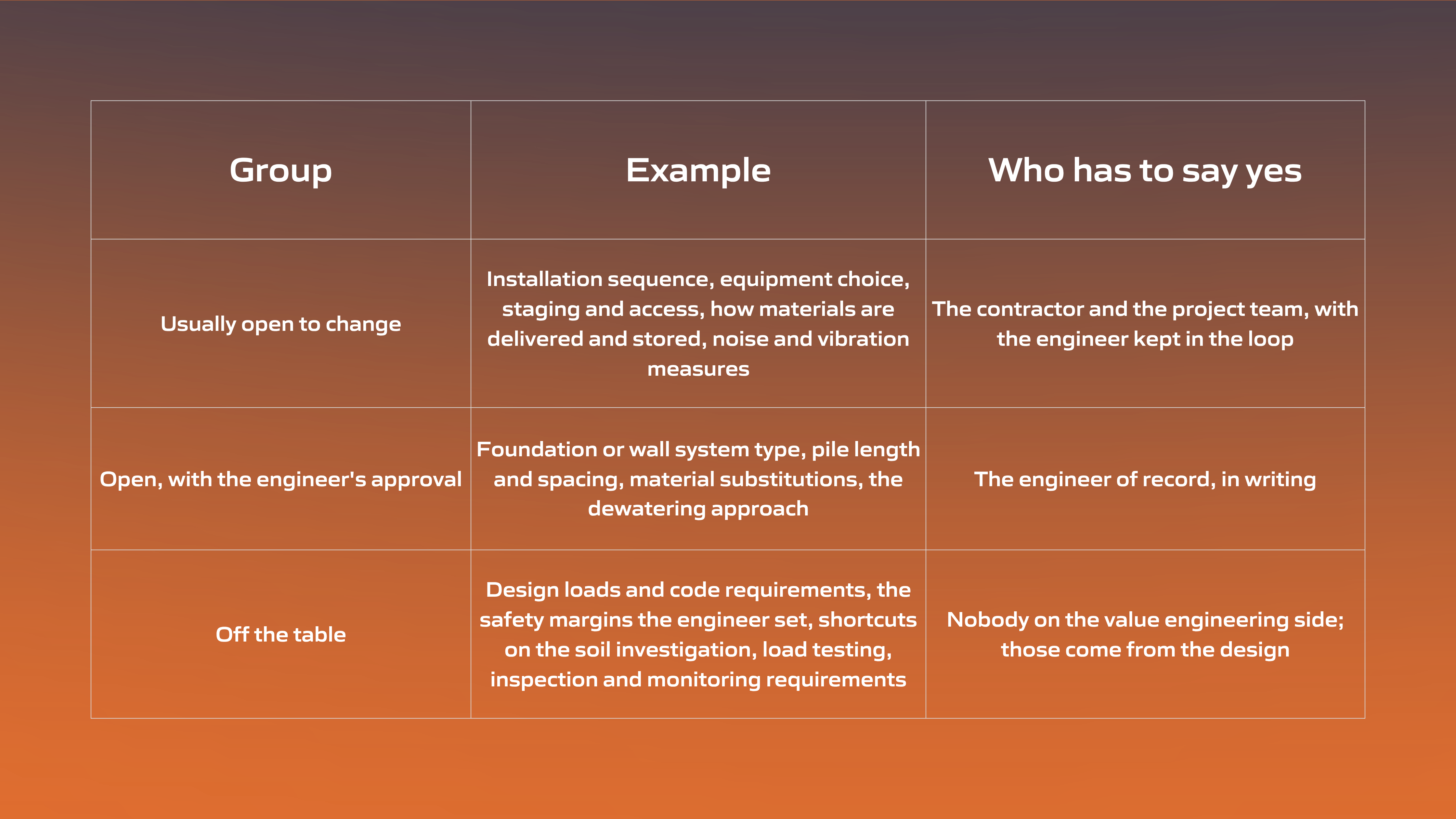
Most of the arguing happens in the middle row. Swapping one system for another can be a great move on the right site, and the answer comes out of the soil and the loads, which our posts on how engineers select a pile system and how load requirements shape the choice walk through. It doesn't come out of a price list.
The bottom row is where we'd slow down. Those lines can get squeezed when the budget is tight, and nobody notices they're gone until it's late. Pile load testing tells you the foundation holds before a building is sitting on it. Instrumentation and monitoring tells you what the ground is doing next to a neighbor. Cut either one and you do save money. You also lose the one way you'd have found out something was going wrong.
Why South Florida sites make the question harder
Soft soil, a high water table and tight urban lots all shrink the list of things that will work. Our value engineering page says the focus is field-aware, constructable recommendations for complex South Florida sites with soil, access and water challenges.
Think about a block with a neighbor on each side. A method that needs a big rig and a lot of elbow room just doesn't fit there, however good it looked on the plans. A quieter, low-vibration system might cost a bit more to install and still come out ahead once you count the headache of a complaint or a stop-work call. We can't tell you which way it goes without seeing the site, and that's why we want the field crew in the room when the review happens.
Terms Worth Knowing Before a Value Engineering Proposal Lands on Your Desk
A few words start flying around once a proposal is on the table, so here's what they mean.
The engineer of record is the licensed engineer the project was designed by. If a change touches the design, that person signs off, in writing, and a friendly "that should be fine" from somebody else doesn't count. Constructability means can we actually build this, on this site, with this access, in this order. A constructability review is the check you run before anyone mobilizes.
An alternative is a proposed swap for something in the original design. Ask for the reasoning along with the price, since a good one arrives with both. Life-cycle cost is what the structure costs over its whole life instead of the number on today's bid, and it's how we read "lowest overall cost" in those definitions above. A foundation that's cheap now and needs attention later has only moved the bill to somebody else.
When value engineering isn't the answer
Some designs are already about as tight as they'll get. Push on one anyway and you usually end up with changes that look good in a spreadsheet and cause trouble in the field.
Timing is the other one. Once crews have mobilized, changes cost more, as our older post puts it, and that hasn't stopped being true. Do this before the first rig shows up, which is also why FHWA puts the review in the concept and design phases.
If the soil information is thin, there isn't much to trim yet. You can't safely cut a design around ground nobody has measured, so get better data first. The same goes for savings that only exist on paper. FHWA's process page warns about overstating them and double counting them, and that applies to a small job as much as a highway.
How Piling Pros approaches value engineering
We work in four steps. The first is boring on purpose: we read the drawings, the soil data and the site constraints so we know what the design is after. Then we look at how it would actually get built here. After that we put alternatives in front of the project team and the engineer, with our reasoning attached, and then we stay involved during implementation so what gets chosen is what gets built.
A recommendation starts from the load requirements and the schedule, not from a favorite method. Most of that gets sorted out in the early planning conversation.
Mistakes
Treating it as a price-cutting round is the big one. If the only question anybody asks is where we can shave, you'll end up shaving the things that protect the project.
Then there's the alternate nobody ran past the engineer of record. That one can sit quietly for months and then show up at an inspection.
Cutting testing and monitoring to hit a number is a bad trade. It's the cheapest line to remove and the one you'd want most the day a neighbor's wall cracks.
Counting the same savings twice happens easily when two changes overlap, and FHWA calls that out by name.
And the quiet one: changing something and never writing it down. A year from now somebody will ask why, and "we think we changed it because..." is a rough answer to give.
Frequently Asked Questions
Is this just a polite way of saying cut costs?
No. Cutting costs asks what we can take out. Value engineering asks what the project has to do and whether there's a better way to get there. Sometimes the better way costs less and sometimes it doesn't, and that second result is still useful.
When should it happen?
Early, ideally while the design is still open, which is where FHWA puts it too. Once crews are on site, everything costs more and disrupts more.
Who signs off on a change?
If it touches the design, the engineer of record, in writing. Methods, sequence and logistics can usually be settled by the project team, but tell the engineer anyway.
Can it make a job faster?
Sometimes. FHWA lists a shorter project time among the aims of a review, and a better sequence or an easier-to-install system on a tight site can do it. If the faster schedule means skipping a test, though, don't take it.
Is a small project worth the trouble?
Depends on the site. If there are real alternatives and access is awkward, a short review can be worth the time. If the design is simple and the lot is wide open, there may be nothing to find, and that's fine.
What to Do Next
Weighing options before a project starts, or holding a proposal and not sure what's safe to change? Send Piling Pros your project details and we'll go through it with you.