
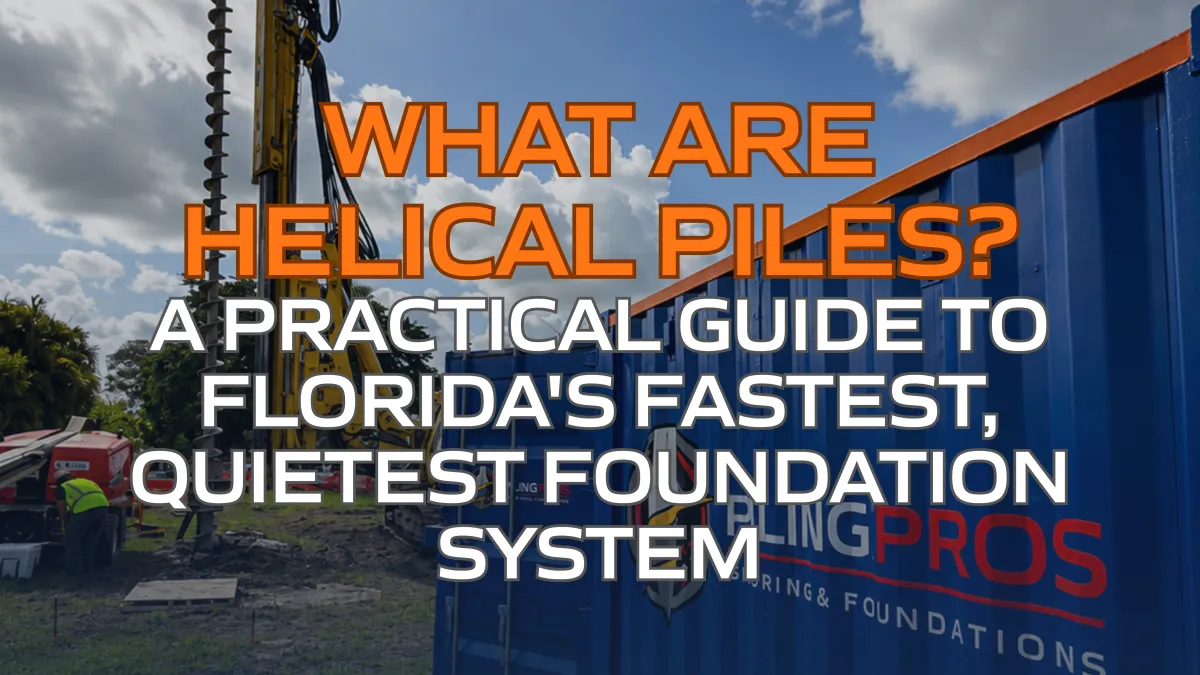
What Are Helical Piles? A Practical Guide to Florida's Fastest, Quietest Foundation System
A helical pile is a steel shaft with one or more helix-shaped plates welded onto it, driven into the ground by turning it, not hammering it. The plates bite into the soil the way a screw bites into wood, and as the shaft advances, it carries a hydraulic torque motor's readout with it. That torque number is the whole trick: soil resistance to turning correlates closely enough with soil resistance to bearing load that installers can estimate a pile's capacity in real time, while it's still going in.
Compare that to a driven pile, which gets its capacity confirmed after the fact, often with a separate test. A helical pile tells you something useful the moment it's installed. That's a meaningful difference on a tight schedule, and it's a big part of why the system shows up so often on Florida projects where soft soil, high water tables, and cramped urban lots make other foundation types harder to pull off. Piling Pros treats helical piles as one tool in a broader deep foundation toolkit. The decision of whether to use them comes down to site conditions more than preference, the same logic that drives the comparison in sheet piling vs. helical vs. micro piles.
Table of Contents
Why "Screw It In" Undersells What's Actually Happening
Picture a large steel screw, minus the exaggeration, and you're most of the way to understanding a helical pile. A lead section carries one or more round steel plates, pitched like a screw thread, welded at set spacing along the shaft. Extensions get added as the pile advances, and the whole assembly gets turned into the ground with a hydraulic motor mounted on an excavator or a smaller rig, depending on access.
Nothing gets pounded. Nothing gets vibrated into the soil the way a driven pile or a vibratory sheet installation does. The plates advance downward with each rotation almost exactly like a wood screw, which is a big part of why job sites near existing structures, underground utilities, or nervous neighbors tend to gravitate toward this system (a theme covered in more depth in how piling work affects the properties around it).
Where Helical Piles Earn Their Keep
Four situations come up again and again.
Additions and remodels on soft or previously disturbed soil are the classic residential case. A homeowner wants to add a room or a second story, and the existing footing wasn't built for the extra load. Light-to-medium commercial work is the second, especially where speed matters more than raw capacity. Equipment pads, modular buildings, and storage structures fall into a third bucket, since these loads are often modest and predictable. And waterfront work docks, piers, bulkhead supports rounds out the list, largely because helical piles handle the combination of soft, saturated soil and access constraints that waterfront sites tend to throw at a foundation crew.
Emergency and repair work deserves its own mention. When an existing foundation has settled or cracked, getting heavy equipment and vibration anywhere near the structure can make things worse before they get better. Helical piles let a crew stabilize a footing without adding to the very problem they're trying to fix, which is one reason they show up so often in projects strengthening existing buildings.
How Installers Verify Capacity Without a Separate Load Test
Every helical pile installation records installation torque continuously as the pile advances, and most rigs display it in real time on a torque indicator mounted in the cab. Empirical correlations, developed and refined over decades of field data, relate that torque reading to the pile's ultimate bearing or uplift capacity. Get a soil that resists turning more than expected, and the torque climbs; get soil that resists less, and it stays low. Either way, the installer has a running estimate of what the pile can hold before the rig ever leaves the site.
That doesn't mean torque correlation replaces engineering judgment or, on critical projects, an actual load test. It means a helical pile installation generates verification data as a byproduct of installing it, which is a real advantage over systems where capacity confirmation is a separate, scheduled event. For projects where the stakes call for direct proof rather than a correlation, the same principles covered in how pile load testing works still apply: a helical pile can be statically or dynamically tested exactly like any other deep foundation element, and the industry's own technical committee continues to refine how that verification gets done as more field data comes in.
Terms Worth Knowing Before You Read a Helical Pile Spec Sheet
The lead section is the first segment of shaft installed, carrying the helix plate or plates that do the actual load-bearing work once the pile is seated.
Torque correlation is the empirical relationship between installation torque and estimated pile capacity; the mechanism that lets a helical pile installation double as a rough real-time capacity check.
An extension is any additional shaft segment added after the lead section to reach the required installed depth, connected with a coupling that keeps the shaft straight and able to transmit torque.
And an ICC-ES evaluation report is a third-party document confirming that a specific manufacturer's helical pile product meets recognized structural acceptance criteria, worth asking for by name if a proposal names a particular brand or system.
Where Helical Piles Stop Being the Right Answer
They're not a universal substitute for driven piles, sheet piling, or drilled shafts, and treating them like one is where projects run into trouble.
Very high axial loads push past what a reasonably sized helical shaft and helix configuration can carry economically. At some point, a larger driven pile or a drilled shaft becomes the more sensible choice on cost alone. Soil with buried obstructions, dense rock, or heavy debris can stop a helical pile's advance well short of design depth, since there's no practical way to hammer through an obstruction the way some driven systems can. And very large permanent structures with heavy lateral load demands, like tall retaining walls or major marine bulkheads, typically call for a different system entirely: sheet piling sized for lateral earth pressure rather than a helical foundation designed mainly for axial load.
How Piling Pros Approaches Helical Pile Projects
The starting point isn't the pile. It's the site: soil borings, groundwater depth, access constraints, and the actual loads the structure will place on the foundation, evaluated together before anyone recommends a system.
Where a helical pile fits, that recommendation gets made because the soil profile, load requirements, and site access line up in its favor, not because it happens to be the fastest or cheapest option on paper. Where it doesn't fit, the same evaluation points toward driven piles, micropiles, or a different deep foundation system instead. That evaluation-first approach is what keeps a foundation decision from becoming a guess dressed up as a recommendation.
Mistakes That Cost Time or Money Here
Choosing helical piles on speed alone, without an engineering evaluation. Fast installation is a real advantage, but it doesn't override the actual soil and load requirements at a given site.
Skipping a geotechnical report because "it's just a small addition." Small structures still transmit real loads to real soil, and undersized helical piles fail the same way any undersized foundation does.
Assuming torque correlation is a substitute for testing on a critical structure. It's a strong real-time indicator, not a replacement for a static or dynamic load test where the consequences of being wrong are serious.
Ignoring buried obstructions during planning. A helical pile that refuses at eight feet because of old debris or rock isn't a defect in the system; it's a sign the site wasn't fully investigated before installation began.
Frequently Asked Questions
How deep do helical piles typically go?
It depends entirely on the soil profile and required capacity; some installations reach bearing capacity in under ten feet, others need forty feet or more of extensions to get past soft or disturbed soil layers.
Are helical piles permanent, or just for temporary support?
Permanent. Properly specified helical piles are designed and installed as long-term foundation elements, not temporary shoring, and they carry structural loads for the life of the building.
Can helical piles be used in place of a poured concrete foundation?
In many residential and light commercial applications, yes, they connect to a structure through a bracket or pile cap rather than a continuous poured footing, which is part of why they install so much faster.
Do helical piles work in Florida's sandy, waterlogged soil?
Often, yes, the combination of soft upper soil layers and a high water table is exactly the condition helical piles were designed to handle, though a site-specific evaluation always comes before that assumption gets locked in.
What to Do Next
If speed, limited access, or vibration sensitivity are shaping how you're thinking about a foundation, it's worth finding out whether helical piles actually fit the site before assuming they do or ruling them out. Send Piling Pros your project details and we'll evaluate it against your actual soil and load requirements.