
What Is Grouting? How Injected Grout Stabilizes Soil, Fills Voids and Controls Water
Grouting means pumping a material, usually cement-based, into the ground through drilled holes so the ground does something you need it to do. Get stronger, fill an empty pocket, let less water through. Caltrans' grouting guidance describes it as injecting liquid, suspension or semi-solid mixes under pressure through boreholes, and that's about as plain as the definition gets.
Most of what grouting fixes is out of sight, so owners tend to meet it the day pavers sink or a slab cracks. Piling Pros uses grouting for soil stabilization, void filling, foundation support and water control around South Florida, where the soil is soft and sandy and the water is never far down. Here's how the main methods work, where each one fits, and where grouting is the wrong tool.
Table of Contents
Why South Florida ends up needing it
Terms Worth Knowing Before a Grouting Proposal Lands on Your Desk
When grouting isn't the answer
What grouting is for
Four jobs cover most of it.
Soil stabilization is the plainest one. You inject into weak or loose ground so it can carry what you're about to put on it. Void filling gets more attention, because the void might be a sinkhole, a cavity, or a pocket left behind by a leaking pipe. Foundation support means reinforcing a foundation that's already there, or one that's about to go in. And water control is sealing leaks and slowing water that wants to get into a structure or move through the soil.
You'll see it on roads, bridges and utilities too. Highway engineers use it to control settlement and fill cavities, and Caltrans also lists lifting pavement and building water barriers among the reasons.
Why not dig everything out and start over? Mostly because of cost and disruption. Caltrans' guidance says grouting is usually less disruptive and less costly than removing and replacing the ground. It also says most methods can move the ground or stress a structure when they're done badly, and we'll come back to that.
The main ways it's done
There's no single thing called grouting. Caltrans describes four methods, and they behave very differently from one another.
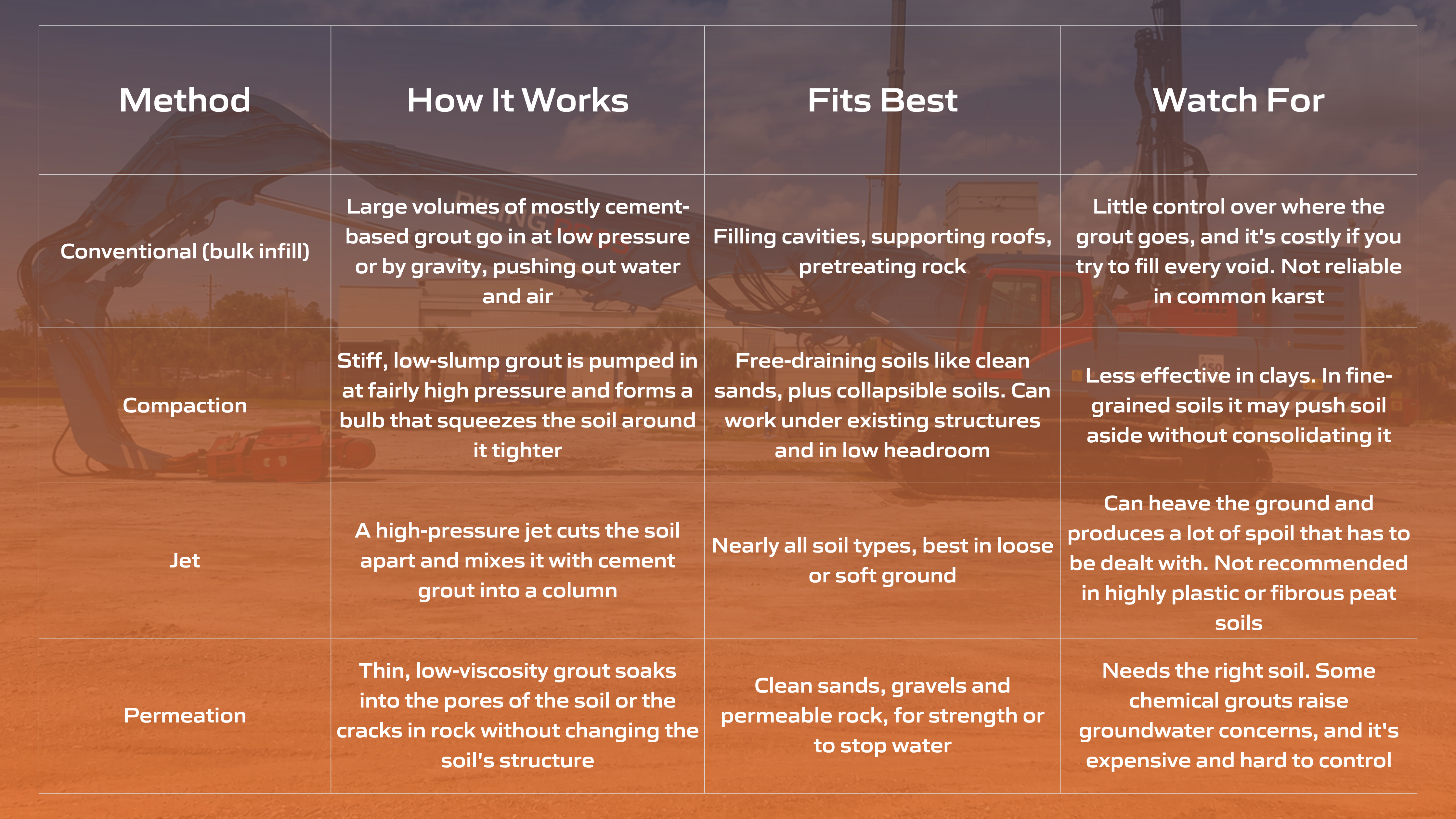
Piling Pros' own grouting page doesn't commit to one of these. It says grout types and injection methods get chosen to suit each site, and that's the right way to look at it. The soil decides what you're even allowed to consider.
The difference between compaction and permeation is worth a minute, because people mix them up. Compaction grouting doesn't cement the soil together. It shoves the soil together with a bulb of stiff grout. Permeation grouting leaves the soil where it is and fills the spaces between the grains. Caltrans even gives a rule for the second one: it's readily suitable in soils with under 12 percent fines (more on fines below) and not suitable once you're over 20 percent.
Why South Florida ends up needing it
Two things stack up here. The soils are soft and sandy, and the water table is high. Piling Pros' grouting page combines those two factors to explain why grouting matters for foundation reinforcement and soil stabilization in the region, and our soil conditions post explains how they affect foundation design.
Then there's the rock. USGS describes much of Florida as sitting on limestone, and groundwater can dissolve limestone, leaving voids underground. The ground can hold for years and then collapse once the void gets too big to bridge. USGS also points to what happened near Dover in January 2010, when groundwater dropped to record lows during a freeze while farmers pumped to protect their crops, and more than 110 sinkholes formed.
That last one is a useful reminder that water and ground are linked. Pulling water out of the ground, even for a good reason, changes how the ground behaves, and it's one reason we treat dewatering planning as part of the foundation conversation instead of a separate task.
Terms Worth Knowing Before a Grouting Proposal Lands on Your Desk
A handful of words come up in almost every grouting proposal, so here's what they mean in plain terms.
A void is just a space underground. A hole that keeps swallowing grout is telling you something: either you found a big void, or the grout is escaping somewhere you didn't plan for. Grout take is the name for how much a given hole accepts, and watching it is how crews learn what's down there.
Injection pressure is how hard the grout is pumped, and it matters more than people think. Push too hard, and the ground moves, and that's why Caltrans warns about heave and ground movement with several of the methods. Heave is exactly what it sounds like: the ground rising because something underneath got pushed.
Fines are the silt and clay-sized particles in a soil. They sound like a detail, but they decide a lot. A soil with few fines lets thin grout soak in, and a soil with many fines won't take it, so a geotechnical report matters before anyone picks a method.
When grouting isn't the answer
Highly plastic clays are the first case. Caltrans says most grouting methods aren't effective in them, so a plan built on grouting clay needs a hard look.
Some jobs need the load carried down to deeper, stronger ground instead of improving the ground you have. That's a deep foundation question, and micropiles are one way to answer it, and they're drilled and grouted. Grout can be part of the solution without being the whole solution.
Large cavities in karst are another. Caltrans says bulk infill gives you little control over where the grout goes and isn't reliable in common karst, and filling every void gets expensive. Sometimes the answer is to treat the ground around a structure and not chase every pocket.
And if whatever caused the void is still active, a leaking pipe or ongoing pumping or water that keeps washing soil out, grouting treats the symptom. Fix the cause or the void comes back.
How Piling Pros approaches grouting
The process runs in four steps, and the first one is the one people want to skip. We start with a site assessment of the soil, groundwater and structural conditions, because everything after depends on what's down there. Then comes system design, where the grout types and injection methods get chosen to suit that site. After that, the team coordinates installation to keep disruption to ongoing work low, and the final step is monitoring and quality assurance, confirming the soil and foundation are stabilized.
Monitoring deserves its own mention. Since most methods can move the ground, you want readings that tell you how the ground and any nearby structure are responding while grout goes in. Our post on instrumentation and monitoring covers the tools. If you're not sure whether the problem you're looking at is a soil problem in the first place, what causes foundation problems that require piling is a good place to start, and piling project planning mistakes explains why the geotechnical report comes first.
Owners, if a grouting proposal lands on your desk, ask a few questions. What method is being proposed, and why that one for this soil? What readings will be taken while it's pumped, and who watches them? How will you know it worked? You don't need to follow every calculation, but somebody should be able to answer those without flipping through papers.
Mistakes
Treating grouting like one product is the most common. Bulk infill, compaction, jet and permeation do different things, and picking by price alone can get you a method the soil can't use.
Skipping the site assessment comes next. Grouting is injected blind, in a way, since you can't see where the grout goes, so the more you know about the ground beforehand, the better your odds.
Not monitoring is a close third. Pumping grout into the ground is pushing on the ground, and if nobody is reading anything, the first sign of trouble is a crack.
And chasing the symptom. A void from a leaking pipe will come back if the pipe keeps leaking, and a sinkhole problem tied to groundwater changes won't stay filled if the water keeps moving the same way.
Frequently Asked Questions
Is grouting a permanent fix?
It's meant to be. Piling Pros' page describes durable, long-term results as the goal. That holds as long as the cause of the problem is dealt with too, because a leak or ongoing pumping can undo the work.
Can grouting damage my building or the one next door?
Poorly controlled grouting can. According to Caltrans, most methods can cause ground movement and structural distress, so pressure is controlled and readings are taken during the work.
Can grout fix a sinkhole?
Filling voids, sinkholes included, is one of the jobs on Piling Pros' list. Whether grout is enough depends on the soil, the size of the void and what caused it, and that call belongs to an engineer who has looked at the site.
Will you have to tear up my yard or slab?
Grouting goes in through drilled holes, so it's usually less disruptive than excavating. Caltrans says compaction grouting can work under existing structures and in low headroom, and that helps when access is tight.
How do you choose a method?
The soil leads. A geotechnical report tells you what the ground is made of, how much water is in it, and what methods are even possible, and the design follows from that.
What to Do Next
If you're seeing settlement, soft ground or a void you can't explain, send Piling Pros your project details and we'll help sort out whether grouting fits your site.