
Is Your Seawall Failing? What Waterfront Owners Notice First
Say you're out on the dock one evening and notice the lawn near the water has dropped an inch or two, like somebody scooped it out with a spoon. Or the water along the base of the wall looks a little cloudy at low tide and you can't think why. Neither one proves a thing. They're also exactly how a lot of seawall trouble starts, because the part of a seawall that fails is usually the part you can't see.
We're Piling Pros, and we do foundation and support work along South Florida shorelines. This post is written for the owner who has just spotted something odd and wants to know what it might mean. It covers what to look for, why walls fail, what you can do yourself this week, and when it's time to bring in somebody licensed.
Table of Contents
Terms Worth Knowing Before a Seawall Report Lands on Your Desk
What owners notice first
Most owners never look at the wall itself. They notice what it's holding up: the yard, the patio, the pool deck and the dock. A depression in the grass, pavers that have started to tilt, a gap where the dock meets the wall: those are usually the first clues, and they show up long before anything on the face of the wall looks wrong.
The City of Marco Island's seawall owners manual is a good plain-language guide, and it lists the signs in the same order most people run into them: sinkholes behind the wall, backfill visible in the water at the joints between slabs (it says this is easiest to spot at low tide), rust on the cap or slabs, a deteriorating or cracking cap, wavy or sagging panels, and slabs tilting out of vertical. Here's how those line up against some of the more ordinary explanations.
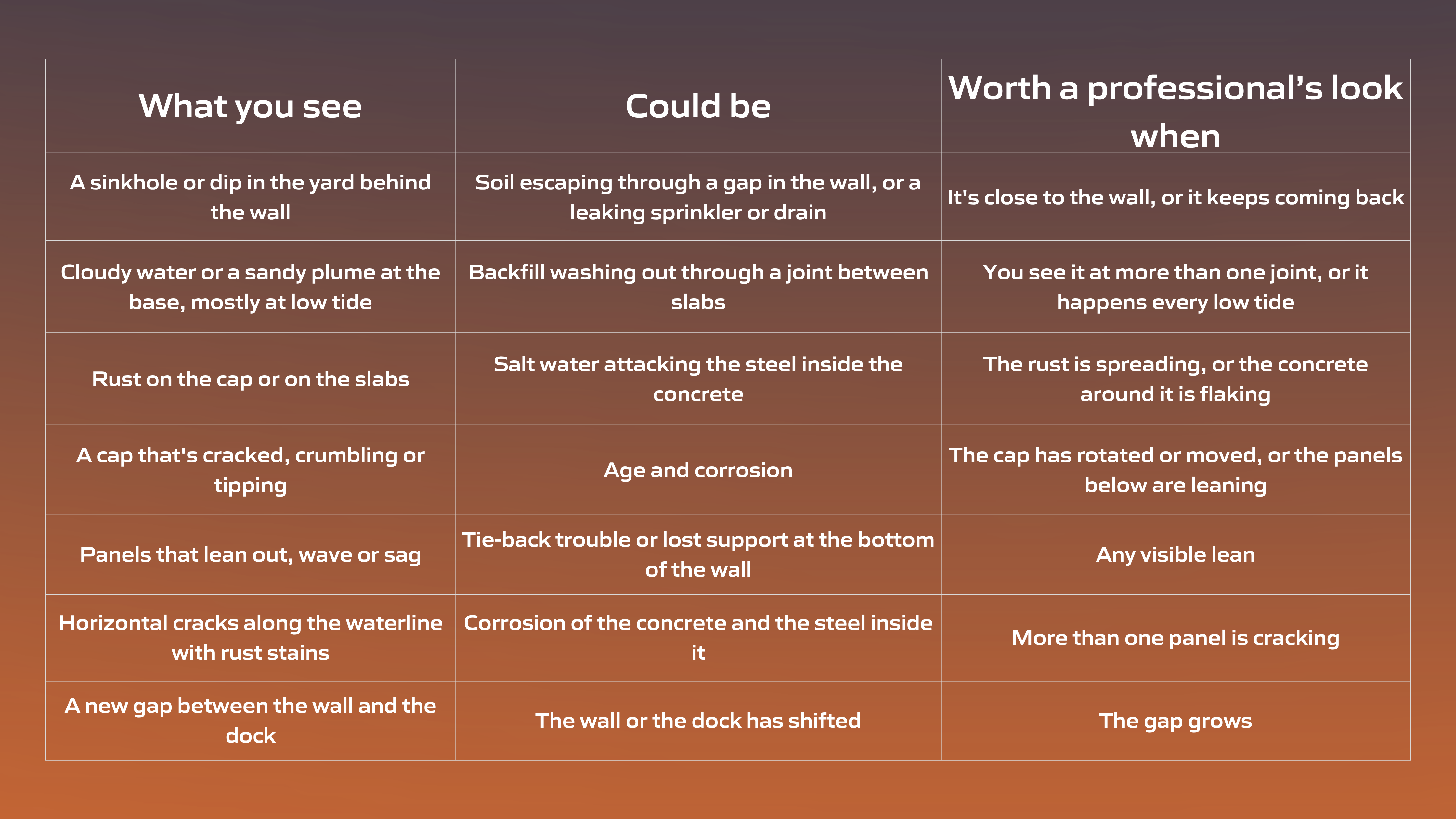
If you can only do one thing, walk the shoreline at low tide with your phone. A wall that looks perfectly fine at high water can show you a lot more when the tide drops and the joints and the base are exposed.
Why seawalls fail
Most of the failure happens behind and below the panels, so it helps to know what's going on back there. A seawall is a wall holding up soil, and the water on the other side pushes back. Marco Island's manual says that difference in pressure, especially at low tide, when the water outside the wall sits lower than the water in the ground behind it, is one of the major causes of seawall damage. Soil gets pushed toward the water, and it finds the gaps.
Age plays a part too. The manual says most of that city's seawalls were designed for a 30-year life and that many have reached or passed it. That's the manual's statement about its own city, and your wall's story could be different, but it's a useful reminder that these walls aren't forever.
The manual also names a few other things that wear on a wall. Salt water corrodes the steel in the cap and in the tie-back rods, the rods that hold the wall back from tipping. The berm at the bottom of the wall can wash out, often from wave action or boat wakes, and the manual offers less than two or three feet of berm as a rough check, not a hard line. A wall can also be getting pushed from the land side. Sprinklers that soak the ground behind it, roof and yard drainage that dumps toward the water, big trees, heavy equipment parked near the edge, and even a neighbor's sagging wall all show up on its list.
None of those causes works alone. A corroded tie-back rod doesn't matter much until the soil behind the wall gets wet and heavy, and a washed-out berm doesn't matter until a few things push the wall at once. That's why two walls the same age can end up in very different shape.
What to do this week
Start with photos. Shoot the wall from the water side and the land side, close up and wide, and date them. Take a few at low tide and a few at high tide if you can. If you see a sinkhole or a gap, put something next to it for scale, and take another picture a week later. An engineer or contractor will get a lot more from a month of dated pictures than from a description over the phone.
Next, walk the yard and check what's pushing on the wall. Where do the sprinklers spray? Where does the roof water go? Is there a big tree right at the edge, or a boat lift or heavy equipment parked on the wall? These are the things Marco Island's manual lists, and several of them cost nothing to change.
Then call somebody licensed. The manual says to contact a licensed marine contractor for repairs or replacement, and it says to have a competent professional engineer registered in Florida inspect a waterfront property before you buy it. It also says a diver inspecting underwater will often uncover hidden problems, and that fits with how much of a seawall you can't see from the yard.
One more thing before anyone picks up a tool: permits. The Marco Island manual says all repairs need a permit from the city, and requirements are different from place to place, so call your own city or county first. State rules can apply as well. Florida DEP's post-storm permitting guide shows that a lot turns on whether a wall is being repaired or replaced and where the new one sits. That guide was written around one storm's emergency order, so treat it as a sign of how much the details matter and call your DEP district office before you assume anything.
Terms Worth Knowing Before a Seawall Report Lands on Your Desk
Once someone looks at the wall you'll hear some words that sound like they came from a boatyard, so here's the short version.
The cap is the concrete beam along the top of the wall. The panels, or slabs, are the vertical sections that face the water, and the joints are the seams between them. Tie-back rods tie the wall back to something solid behind it so it can't lean toward the water, and our post on soil anchors and tiebacks goes into how they work. The berm is the soil or rock at the toe of the wall, and the toe is the bottom of the wall itself.
Hydrostatic pressure is the pressure water puts on the wall, and when people say the pressure is uneven they mean the water level on one side of the wall is different from the water level on the other. Weep holes are small openings that let water through so pressure doesn't build up, and Marco Island's manual says they can get clogged with sand or soil, which is why they need to be kept clear. Backfill is the soil behind the wall. If you'd like more on how this fits with the rest of shoreline work, our post on bulkheads explains how a wall at the water's edge holds soil back.
Before you blame the wall
Not every dip in a yard is the wall's fault. A leaking irrigation line can carve out a hollow behind a perfectly good wall, and a broken drain can do the same. A tree that has grown right at the edge can push on a wall for years. Soil that was never packed down well after somebody dug there can settle all by itself.
It's also worth looking down the shoreline. If your neighbor's wall is sagging, Marco Island's manual lists that as something that can affect yours. If the whole stretch is moving, you probably want the neighbors in the conversation.
Then again, the cause of a problem and the fix for it aren't always the same thing, and you can have a dripping sprinkler and a weak tie-back at the same time. That's one reason to get somebody to look instead of fixing the obvious cause and calling it done. Our post on Florida soil conditions shows why the ground itself can change from one lot to the next.
How Piling Pros approaches seawall support
Our seawall support work is about stabilizing and reinforcing existing or new seawalls so they don't fail, settle or wash out. We start by studying the wall and the site, meaning the condition of the seawall, the soil, the water and the loads on it, along with the plans and any geotechnical data. From there we recommend a system that fits both the engineering and what's possible on your shoreline, including whatever limits there are on getting a crew and equipment in.
After that comes the work itself, with the right equipment and crew, and a lot of attention to coordination, since waterfront jobs involve water levels, access and permits at once. Our page lists monitoring and quality checks as part of the process, and for larger jobs our post on instrumentation and monitoring shows how that's done. Our waterfront retention page covers the wider set of shoreline systems, and the post on marine and waterfront piling explains why water, salt and permitting change the way these jobs get planned.
Mistakes
Ignoring the little signs is the big one. A small dip in the lawn can get bigger, and waiting rarely makes the fix any easier.
Filling a sinkhole with dirt and walking away is a close second. If soil is escaping through the wall, new soil just goes the same way, and you've only covered up the evidence.
Then there's picking a repair before anyone has looked at the whole wall. Patching a cap while the tie-backs are corroded is a good way to pay twice.
Another is starting work without a permit. Marco Island's manual says the city inspects completed work for compliance with its code, so it's much easier to ask first.
And don't trust the face of the wall. A seawall can look fine from the yard and still be in trouble behind the panels, and that's why the manual suggests a diver inspection.
Frequently Asked Questions
How do I know if my seawall is failing?
Look at what the wall is holding up. A sinkhole or dip behind it, soil or sand showing up in the water at the joints, a cap that's cracking or tipping, and panels that lean or sag are all on the Marco Island manual's list. One of them doesn't mean the wall is done, but it does mean somebody should look.
Can I fix a seawall myself?
You can take care of the things around it, like moving a sprinkler, clearing weep holes or keeping heavy equipment off the edge. Repairs to the wall are a different story. The manual says to use a licensed marine contractor and says all repairs require a city permit.
Who should I call first?
For repairs, a licensed marine contractor. For an opinion on the structure, especially before buying, a professional engineer registered in Florida.
Do I need a permit to repair a seawall?
Probably. Marco Island's manual says all repairs need a city permit, and DEP's post-storm guide shows the state cares about repair versus replacement and where the wall sits. Rules vary by location, so check with your city or county and your DEP district office before work begins.
How long does a seawall last?
It depends on the wall. Marco Island's manual says most of its city's walls were designed for a 30-year life and many have reached it, so age is worth knowing. Salt, water pressure and what's happening behind the wall all change the answer.
What to Do Next
Spotted something odd along your shoreline, or looking at a wall report you're not sure about? Send Piling Pros your project details and we'll tell you what we'd check first.