
What Is a Bulkhead? How Bulkheads Hold Back Soil Along South Florida Waterfronts
Walk along almost any canal in South Florida and you're walking next to a bulkhead, whether you noticed it or not. It's a vertical wall at the water's edge, built to hold the land in place so the soil doesn't slide, slump or wash into the water. The part you see is usually a cap and a face. The part doing the work is mostly buried.
Piling Pros designs and builds bulkheads for shoreline stabilization, canals, residential waterfronts and commercial sites like marinas. This post covers what's inside one, how they fail, and what to ask before you pay for a new one.
Table of Contents
Why South Florida is hard on them
Terms Worth Knowing Before a Bulkhead Proposal Lands on Your Desk
When a new bulkhead isn't the answer
What's inside a bulkhead
Think of a bulkhead as five parts working together. A vertical face holds the soil back. The bottom of that face, called the toe, is driven into the ground below the water so the wall can't kick out. Along the top there's usually a cap. Behind the wall, rods run back to anchors set a safe distance inland, and the soil behind the wall (the backfill) sits there under pressure, waiting for any gap it can find.
A 1975 Florida Sea Grant report from the University of Florida describes the setup the same way. The face is precast concrete slabs or steel or wood sheet piles driven into the bottom, and the wall depends on how deep it's driven and on its tie-backs for stability. The report is old, and its costs and permitting details are out of date, but the mechanics of how a wall like this stands up haven't changed.
That's the key idea. A bulkhead isn't just a wall. It's a wall, a foundation under the wall and a tie system behind it, and if any of those three fails, the others can't make up for it.
Bulkhead or seawall?
People use the two words interchangeably, and on a canal lot the difference rarely matters to the owner. The Sea Grant report itself treats bulkheads as seawalls.
If you want the rough split, a bulkhead is mainly there to hold soil, and a seawall is built to take wave and surge forces head on. A lot of walls along canals do a bit of both. Piling Pros also has a seawall support page, so if you're not sure what problem you have, that's a good question for the first site visit.
What they're made of
The Sea Grant report names three face materials: precast concrete slabs, steel sheet piles and wood sheet piles. Steel, vinyl and concrete sheet piles are the choices you'll hear about most today, and the right one depends on water chemistry and loads. We cover that choice in steel vs. vinyl vs. concrete sheet piles, so we won't repeat it here.
What's worth saying here is that the material gets less attention than it deserves compared with the stuff you can't see. A good face on a short toe or weak anchors is still a failing wall, just a slower one.
How bulkheads fail
The same Sea Grant report lists the ways these walls go wrong, and the list has held up well. Here it is in plain terms.
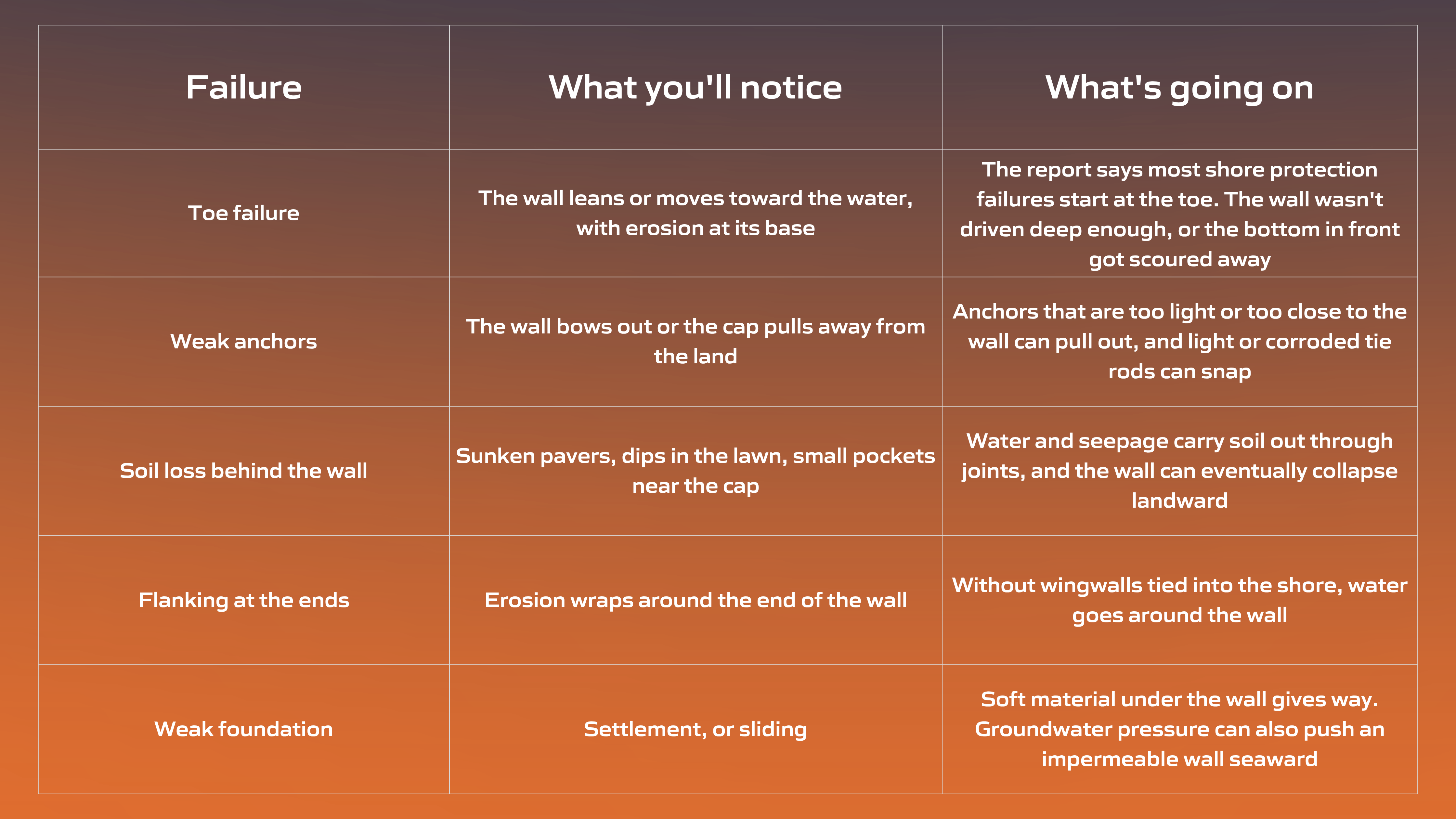
Waves make the toe problem worse. The report explains that waves hitting a vertical face bounce up and down, and the downward part scours the bottom at the base. Over enough storms, that scour can cut away the ground the wall depends on.
If you're looking at a wall and you can only see the cap, it's worth remembering that the cap is the last place trouble shows up. Walls with serious toe or anchor problems can look fine from the yard.
Why South Florida is hard on them
Piling Pros' bulkhead page says these structures matter most in places with high water, tides and soft soil, and South Florida has all three. Soft, sandy ground doesn't hold a vertical face on its own, the water table sits close to the surface, and tides move the water level on the outside of the wall while groundwater behind it moves slowly. That difference loads the wall every day.
There's also simple age. A 2018 TRB paper on Florida seawalls says roughly 3,600 miles of concrete seawall lined the state's coast by the time development slowed in the 1970s, and that many of those structures are now past their intended service life. The authors call it a tremendous maintenance and replacement liability, and estimate private property owners carry about 80 percent of that cost.
So if you own waterfront in this part of the country, the question isn't whether your wall will need attention. It's whether you'll find out early. Marine and waterfront piling goes into the corrosion and permitting side of working at the water's edge in more detail.
Terms Worth Knowing Before a Bulkhead Proposal Lands on Your Desk
You'll hear a few terms in any proposal, so here's the short version.
The toe is the buried bottom of the wall, and its depth is one of the first numbers worth asking about. Our posts on how deep sheet piles need to go and how much lateral support they provide explain where that number comes from.
A tie rod is a steel rod running from the wall back to an anchor in the soil. It's the thing that stops the wall from leaning toward the water, and the report says tie rods should be heavily coated or wrapped against corrosion. Anchors can be piles or blocks, and the report calls anchor design a specialty that needs soil mechanics expertise. If you want the longer version of how those anchors work, we have a post on soil anchors and tiebacks.
Backfill is the soil behind the wall, and a filter cloth is a fabric layer behind it that lets water through while holding soil in. It's cheap compared with the wall, and leaving it out is one of the ways soil ends up escaping through joints. Flanking is erosion going around the end of a wall, and a wingwall is the short return that ties the end into the shore and prevents it.
When a new bulkhead isn't the answer
A failing edge doesn't automatically mean a new wall. If the wall itself is sound and soil is escaping through open joints, the Sea Grant report's repair list is a good place to look: adding or replacing tie rods, adding anchor blocks, placing larger stone at the toe, and putting filter cloth behind the wall to stop soil loss.
Voids behind or under an otherwise good wall can sometimes be filled by grouting, and our waterfront retention service covers the broader picture of holding a shoreline when a standard wall isn't the right fit.
On the other side, there are sites where the wall isn't doing much. Gentle slopes with low wave exposure can sometimes handle a softer shoreline treatment, and an engineer should be the one to say so. Piling Pros' own page says bulkhead design is tailored to site soil, tidal and water conditions, a polite way of saying the answer is different on every lot.
How Piling Pros approaches bulkheads
The process has four steps. It starts with a site assessment of the shoreline, soil and water conditions. Then comes system design, where the bulkhead type, depth and reinforcement get worked out. Next is construction coordination, so installation is safe, precise and efficient, and the last step is monitoring and maintenance guidance so the wall keeps performing over time.
A couple of things we'd want an owner to take from that. The depth and reinforcement are design decisions, not defaults. And the work doesn't stop when the wall goes in, since a bulkhead is something you check on, not something you forget about.
If a proposal lands on your desk, a few questions help. How deep is the toe and why that depth? What are the tie rods made of, and how are they protected from corrosion? What's behind the wall to stop soil from leaving through the joints? You don't have to follow the calculations, but the answers should exist.
Mistakes
Designing for a calm day is the classic one. A wall that holds at normal water can fail in a storm tide, so the loads for that storm have to be in the design from the start.
Leaving out drainage and filter details to save money is the quiet one. You won't see the problem for a few seasons, and then the backfill starts to leave, and the repair is a lot bigger than the filter cloth would have been.
Underbuilding the anchors is another. The Sea Grant report is clear that anchors that are too light or too close, and tie rods that are light or corroded, are a recognized way for these walls to fail.
Forgetting the ends is easier to do than you'd think. Without wingwalls tied into the shore, erosion goes around the wall, and the best-built stretch in the middle doesn't matter.
And waiting is the expensive one. A soft spot in the lawn or a paver that's dropped a little is the wall telling you soil has found a way out, and it's cheaper to deal with then than after the wall moves.
Frequently Asked Questions
How do I know if the soil behind my bulkhead is washing out?
Look for pavers that have settled, dips in the lawn, small pockets near the cap, or gaps between the cap and the ground. Those usually show up before the wall visibly leans.
Is a bulkhead the same as a seawall?
Close enough in everyday use, and the Sea Grant report treats them as the same thing. The textbook split is that a bulkhead holds soil and a seawall takes wave forces, but plenty of canal walls do both.
How long does a bulkhead last?
It depends on the material and the water. The Sea Grant report notes that steel corrodes fastest in the splash zone and that wood faces decay and get attacked by marine borers, so protection matters. The TRB paper adds that many Florida seawalls are already past their intended service life. A real lifespan needs an inspection, not a guess.
Can a leaning bulkhead be repaired instead of replaced?
Sometimes. If the wall is sound and the problem is tie rods, anchors, or soil loss, repair can be enough. If the toe has been undermined or the wall is moving, you're probably looking at reinforcement or replacement, and an engineer should make that call.
Do I need a permit for bulkhead work?
Usually, yes, and both your county and the state may be involved. It's worth asking about permitting at the start, since it can set the schedule.
What to Do Next
If you've got soft ground behind a wall, or you're planning a new shoreline and want the right system before you commit, send Piling Pros your project details and we'll help work out what your site calls for.