
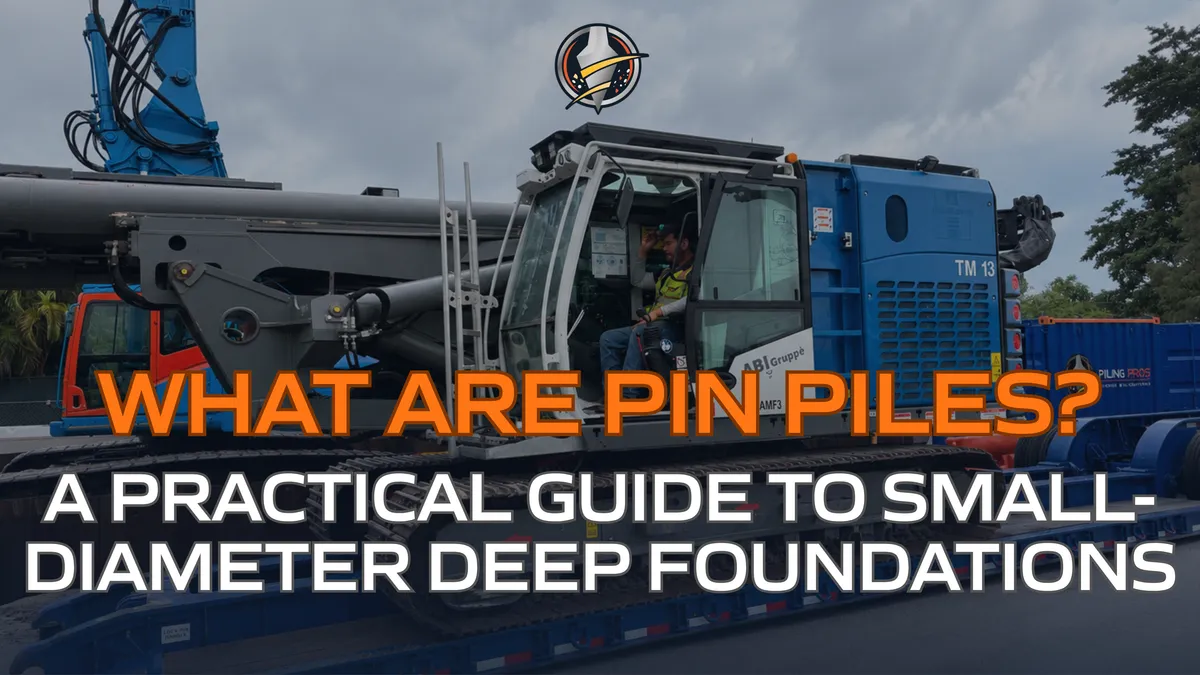
What Are Pin Piles? A Practical Guide to Small-Diameter Deep Foundations
Ask someone to picture foundation work and they'll usually picture something too big to fit anywhere tight. Pin piles are the exception. They're small-diameter foundation elements, generally 4 to 12 inches across, put in by drilling a cased hole to bearing depth, running a steel bar or pipe down the center for reinforcement, and pumping the shaft full of grout under pressure. A rig built for this work can squeeze into a basement stairwell or operate under an eight-foot ceiling, and what comes out of that narrow footprint can still carry real structural load.
A bigger rig usually buys more capacity per pile. Giving that up usually buys access to a site nothing bigger will fit into. Pin piles are one of the few systems that split that difference, which is why Piling Pros installs them on jobs where the equipment itself would otherwise rule out the project: tight urban lots, interior underpinning, marine work reachable only by barge, and industrial sites where standing machinery or storage racking leaves no room to maneuver a conventional rig.
Table of Contents
How a Pin Pile Actually Gets Built
Why Pin Piles Get Specified Over Larger Systems
Pin Piles vs. Micropiles vs. Helical Piles
Terms Worth Knowing Before a Pin Pile Proposal Lands on Your Desk
Where Pin Piles Aren't the Right Call
How Piling Pros Approaches Pin Pile Projects
How a Pin Pile Actually Gets Built
Installation starts with casing, plain steel pipe advanced into the ground with rotary drilling or a small percussive hammer, whichever the soil or rock at that spot calls for. The casing's only job at this stage is holding the hole open. Pin pile diameters are narrow enough that the ground often won't stay open on its own the way a wider drilled shaft sometimes will.
Once the casing reaches bearing depth, a steel bar or pipe section goes down the center, and grout gets pumped into the shaft under pressure, pushing into whatever fractures or voids exist in the surrounding rock or soil. Some designs leave the casing in the ground permanently. Others pull it as the grout cures, and which way a given project goes usually comes down to the corrosion protection spec. Either way, most of the finished pile's capacity comes from friction along that grouted length, with the tip adding some bearing capacity of its own if it lands on rock. DFI's Micropile Committee works this same territory, since pin piles and micropiles overlap enough in practice that the two terms get used almost interchangeably on some job specs, and its published guidance is worth a look whenever either term shows up in a proposal.
Why Pin Piles Get Specified Over Larger Systems
Access drives most pin pile decisions before capacity ever enters the conversation. A rig that can install pin piles often fits through a standard doorway or basement stairwell, which means underpinning work can proceed inside an occupied structure without demolishing a wall to get equipment in. That single fact explains why pin piles show up so often on retrofit and remediation projects rather than new commercial builds, where a full-size rig usually has room to operate anyway.
Vibration matters just as much on projects near sensitive structures. Drilling and grouting produce far less ground disturbance than driving a pile, which keeps pin piles in play on historic buildings, occupied residences, and sites next to structures already showing settlement, where added vibration would just make an existing problem worse. The load capacity a pin pile delivers for its footprint also makes it a practical fix when an existing foundation needs more capacity than it originally had, since there's often no room to widen a footing but plenty of room to drill a small hole beside or through it.
Soil and rock conditions that would slow down other systems tend to matter less here too. A pin pile crew can adjust casing depth and grouting pressure as drilling reveals what's actually below grade, which gives the method some built-in flexibility on sites where subsurface conditions weren't fully known going in.
Pin Piles vs. Micropiles vs. Helical Piles
The line between pin piles and micropiles is more about terminology and scale than a hard technical boundary; both are small-diameter, grouted, drilled elements, and in a lot of the country the two terms get used almost interchangeably. Where a distinction gets drawn, pin piles usually sit at the smaller end of that range and lean more heavily on skin friction, while larger micropiles can be engineered to combine friction with meaningful end bearing on rock.
Helical piles work on a completely different principle: a shaft with helical plates gets screwed into the ground, with capacity confirmed in real time through installation torque. That makes helical piles faster to install and easier to verify on-site, but they're limited by how much torque a given shaft can take and how the soil responds to a screwed-in element, whereas pin piles can be drilled through obstructions and grouted into rock that a helical pile would never get through cleanly.
CFA piles belong to a different category entirely. They're larger-diameter, faster to install per pile on open sites, and depend on continuous concrete placement rather than grout injection, which makes them a poor fit for the exact restricted-access conditions where pin piles do their best work. Driven piles sit furthest from pin piles on that spectrum; FHWA's manual on driven pile foundations acknowledges micropiles and CFA piles as alternatives worth considering on constrained sites, without covering them in detail, since driven piles need open access and clearance that a restricted site usually can't provide in the first place. Choosing among these systems, along with the other deep foundation types common in Florida construction, usually comes down to how much room the site actually gives a crew to work.
Terms Worth Knowing Before a Pin Pile Proposal Lands on Your Desk
The bond zone is the section of the pile shaft, usually toward the bottom, where grout is in direct contact with surrounding soil or rock and where most of the pile's load-carrying capacity actually develops. Everything above that zone is mostly along for the ride structurally.
Casing refers to the steel pipe that holds the drilled hole open during installation. Whether it's left in place permanently or pulled as the grout sets changes both the pile's corrosion protection and, in some designs, how much of its capacity comes from the casing itself versus the grout and reinforcing bar inside it.
A reaction frame is the structure a load test rig anchors against to apply a known force to a test pile, typically using nearby piles or ground anchors to resist the jack's push. Pin pile capacity gets confirmed this way far more often than through installation feel alone, since drilling resistance doesn't translate to load capacity the way driving resistance does for a driven pile.
Point bearing describes the portion of a pile's capacity that comes from the tip resting on rock or dense soil, as opposed to friction along the shaft. Most pin piles rely on a combination of both, and how a designer splits that ratio affects everything from bar size to required embedment.
Where Pin Piles Aren't the Right Call
A tight site alone doesn't automatically mean pin piles are the answer. Sometimes a different small-footprint system, or a change in sequencing, solves the same access problem more efficiently.
Large new-construction projects with normal site access rarely benefit from pin piles, since the per-pile cost and installation rate can't compete with larger systems when there's no access constraint forcing the smaller option. Sites needing very high capacity per pile can also outgrow what a small-diameter shaft can reasonably carry, at which point a larger drilled shaft or a cluster of piles designed differently becomes the more economical path. And where installation-time capacity verification matters most, such as fast-moving projects that need immediate confirmation before the crew moves to the next location, a helical pile's real-time torque feedback can be a better operational fit than pin piles, which typically confirm capacity through load testing after the fact.
How Piling Pros Approaches Pin Pile Projects
Every pin pile project starts with figuring out exactly how much room the equipment actually has, not just how much room the drawings say it has.
Ceiling height, doorway width, floor loading limits for the rig itself, and staging space for grout and materials all get walked through on site before a pin pile gets specified over any alternative.
From there, soil and rock conditions drive the bond zone design and bar or pipe sizing, with load testing built into the plan rather than treated as an afterthought once piles are already in the ground. On underpinning and retrofit work in particular, additional piling installed to reinforce an existing structure has to account for the load path of the building already standing on top of it, which is a different design problem than sizing piles for a foundation that hasn't been built yet.
Mistakes That Cause Problems on Pin Pile Jobs
Sizing the bond zone off of soil borings taken somewhere else on the site, rather than conditions actually encountered during drilling, is one of the more common ways a pin pile job goes sideways. Subsurface conditions can change meaningfully within a short distance, especially in South Florida's mixed soil profiles, and a bond zone designed for the wrong layer simply won't deliver the capacity the engineer assumed.
Skipping or shortcutting load testing to save a day on the schedule causes its own problems, since drilling resistance and grouting pressure are rough indicators at best and don't substitute for an actual test confirming what the pile can carry. Underestimating how much staging space grout pumping and material handling actually need in a tight space is another one worth naming, since a crew that runs out of room to work safely ends up slowing the job down anyway, just later and with less warning.
Treating casing corrosion protection as a minor spec detail rather than a design decision causes problems further down the road, particularly on permanent applications where the casing is expected to carry load for the life of the structure rather than just during construction.
Frequently Asked Questions
What's the actual capacity of a pin pile compared to its size?
It varies with soil and rock conditions, but pin piles routinely carry loads that would surprise someone judging capacity by diameter alone, since the bond zone length and grouting pressure matter more to final capacity than the shaft's width does.
Can pin piles be installed inside an occupied building?
Yes, and that's one of the main reasons they get specified. Rigs small enough to fit through standard doorways and work under normal ceiling heights let underpinning and retrofit work proceed without displacing occupants or demolishing structure to get equipment inside.
How is pin pile capacity verified if there's no installation torque to read?
Through load testing, using a reaction frame to apply a known force and measure how the pile responds. That test happens after installation rather than during it, which is the main practical tradeoff compared to a system like helical piles that reports capacity as it goes in.
Are pin piles more expensive than other deep foundation systems?
Per pile, often yes, since small-diameter drilling and grouting take time and the equipment mobilization isn't necessarily cheap just because the rig is small. The comparison usually only favors pin piles once site access is factored in, at which point the alternative isn't a cheaper pile, it's demolition or a redesign to get larger equipment onto the site at all.
What to Do Next
If a project has a foundation problem and a site that won't let a normal rig anywhere near it, that combination is exactly what pin piles were developed to solve. Send Piling Pros your project details and we'll assess whether pin piles fit your access constraints, your load requirements, or both.