
What Happens on Pile Load Test Day, Step by Step
Say you own a building that doesn't exist yet. The piles are in the ground, and you can't see them anymore. All you have is a stack of installation logs. Then the engineer calls: test is Thursday, come watch if you want.
So you show up in a hard hat. There's a steel frame over one pile, a hydraulic jack underneath it, a few gauges clamped on, and a person with a clipboard. Nothing is moving. That's normal. A pile load test is slow, and most of it looks like waiting.
We're Piling Pros, and we install deep foundations and shoring around South Florida. Our post on how pile load testing confirms a foundation will hold explains the why. This one follows the day itself. You'll see the frame, the gauges, the long waits, and what the engineer does with the numbers at the end.
Table of Contents
Why anyone tests a pile
Design capacity is an estimate. An engineer worked it out from soil data and formulas and experience, and it's usually a sound estimate, but the ground gets the last word. Our load testing guide says it plainly: until a test backs the number up, it stays an estimate.
Inspection can't close that gap. An inspector can tell you the pile went in where the drawings said, at the right depth and diameter. What it can carry now that it's in the dirt is another matter, and a load test is the direct way to find out.
Some systems lean on testing harder than others. Our guides say a CFA pile's capacity gets confirmed after the concrete cures, and a pin pile's gets confirmed by load testing after installation. The helical pile page says installation torque gives a running estimate, but on critical projects it doesn't replace an actual test. The Federal Highway Administration's acceptance circular for structural foundations treats acceptance of a deep foundation as the last step in quality assurance, judged on measurable criteria. A load test gives you measurements like that.
Before the day: getting the pile and the frame ready
Most of the work happens before anybody touches the jack.
First, the pile. Pile Buck Magazine's 2017 article on test methods for driven piles describes the prep: the head gets cut to the right elevation, then capped with a steel plate that can take the load, leveled, and grouted to a concrete head or welded to a steel one. That article covers driven piles. Still, think about it. Push a jack against a crooked surface and the readings are junk.
Then the reaction system, which is what the jack pushes against. Without something heavy or something anchored, the jack would just lift itself. Our load testing guide names weighted platforms, anchor piles and ground anchors. A continuing-education course from CED Engineering walks through two options. One is a dead load platform piled with concrete or steel blocks, water tanks or sand bags. The other is a set of reaction piles with a beam across the top. The course says the reaction-pile route is the routine one, and dead loads are rarer now.
Spacing matters. CED says reaction piles should sit at least three reaction-pile diameters from the test pile, and more than 5 feet away, so the two don't influence each other. Pile Buck agrees on the 5 foot minimum and adds that reaction piles need some way to detect upward movement.
All of that takes room. Our post on site access and logistics is a good reminder to plan for the frame, the delivery of blocks or extra piles, and the crane or excavator before test week.
Now the instruments. A hydraulic jack sits at the center of the test pile. According to CED, load is read by a load cell between the jack and the pile, or by a pressure gauge between the pump and the jack. Movement comes from dial gauges, surveying equipment, or both. Pile Buck wants two independent ways to measure settlement, because gear gets bumped and broken. It also calls for a calibrated jack and load cell with a spherical head, a leak check on the hydraulic lines, and a plan to hold pressure overnight if the test runs that long.
The loading, step by step
Here's roughly what a standard slow test looks like, based on what CED and Pile Buck both describe. Your engineer's spec sets the real numbers. Think of it as a sketch, not a procedure.
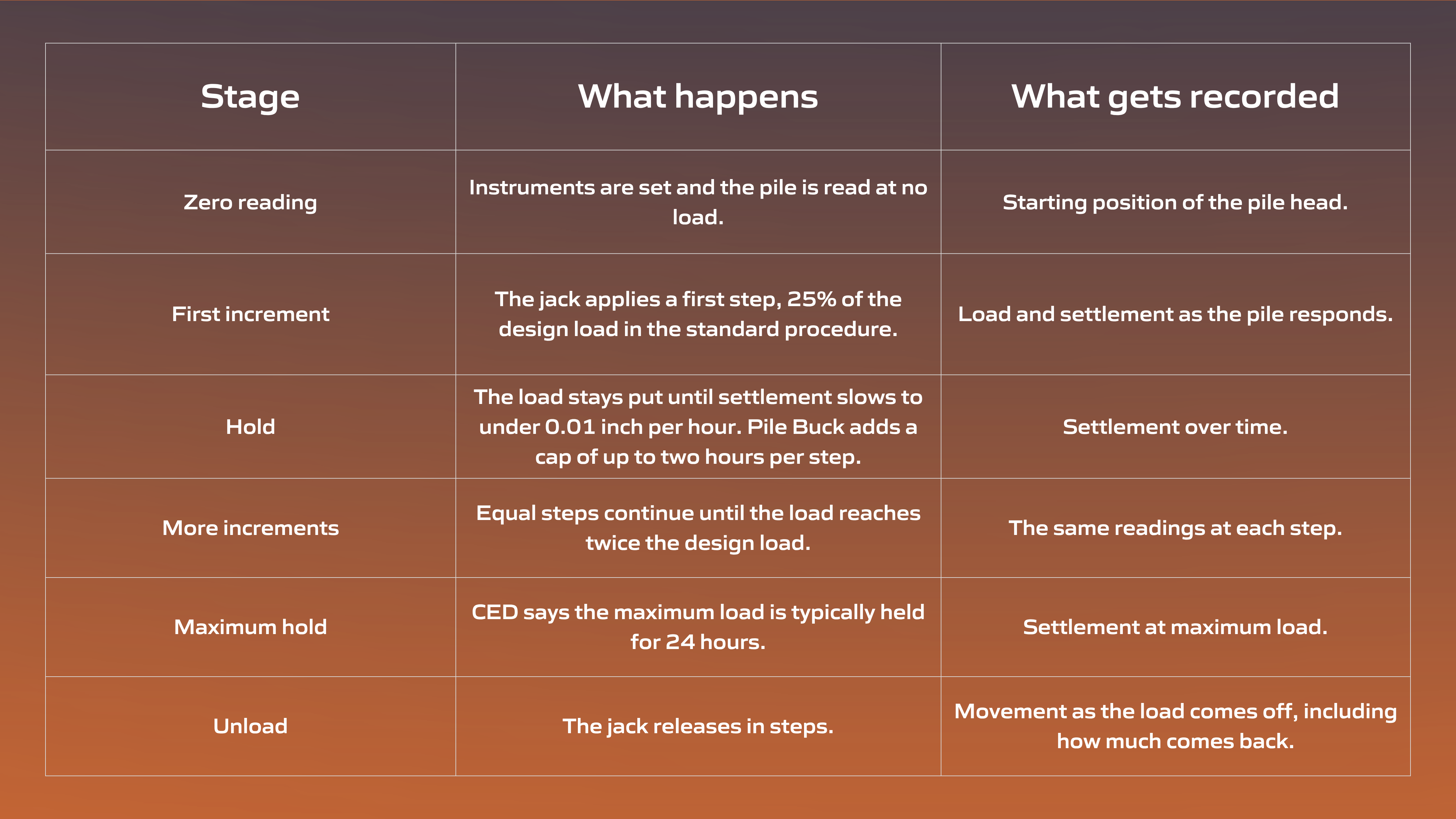
Run the numbers. Steps of 25% to reach 200% add up to eight, and each one gets its own hold. Small wonder the day is mostly waiting.
The long hold and the unload
The hold at maximum load is the longest stretch, and it's the one where people wander off for coffee. Don't. By then, in the standard procedure, the pile is under twice its design load. Whoever watches the gauges has the most important seat on site.
Then the load comes off in steps, and some of the movement can come back. That rebound tells the engineer something, because it separates the movement that was recoverable from the movement that stayed. Our load testing guide lists both as things the test measures, along with the point where the pile stops gaining resistance.
So how long does it all take? It varies. CED says a typical slow maintained test runs 1.5 to 3 days. Our own guide describes static tests as running over hours. Same family of test, different spec, different answer.
Faster tests and the dynamic option
Not every job gets a slow test. CED describes a quick maintained load test with smaller steps of 15% of design load, each held 5 minutes, up to three times design load, usually done in 3 to 5 hours. There are also incremental equilibrium and constant time interval versions, each with its own pace. Pile Buck mentions a quick axial compressive test and warns that because it's quick, clay and similar soils may not have time to consolidate, so settlement can look smaller than it really is.
Dynamic testing works differently. A big hammer hits the pile once, and strain gauges and accelerometers record how the pile answers. Our load testing guide points to ASTM D4945 for dynamic tests and ASTM D1143 for static ones. It's faster and cheaper, per the guide, and gets used more on big pile groups, often calibrated against a static test on a smaller subset.
Static tests are the most direct measurement, and also the slowest and most expensive. That tradeoff is why the testing plan gets settled early.
What happens to the numbers
Jack off, gauges down, and the data heads to the engineer. Load and settlement readings become a curve. The engineer reads that curve against the project's criteria and either confirms or rejects the assumed capacity. Our load testing guide covers the vocabulary: ultimate capacity, allowable capacity, factor of safety. It says most deep foundation work lands in a 2 to 3 factor of safety range, but it gives no source for that, so ask the engineer of record what your project uses.
If the pile did its job, the design stands. If not, what happens next is the engineer's call. It could mean a change in pile count, pile length or the system itself. That's the reason the test comes before the rest of the foundation gets built.
One more thing. A load test doesn't replace monitoring during construction. Our post on instrumentation and monitoring calls pile load testing a different route to the same question, useful for foundations nobody is watching continuously.
Terms Worth Knowing Before a Load Test Report Lands on Your Desk
A few words turn up in every report.
Design load is the working load the pile is meant to carry. Ultimate capacity is where the pile stops gaining resistance, and allowable capacity is the lower number you design to once the factor of safety is applied. Settlement is how far the pile head moves down. Rebound is the part that comes back when the load is removed. The reaction system is whatever the jack pushes against: weighted platform, anchor piles or ground anchors. A load cell measures how much force the jack is applying. The engineer of record is the engineer who signs and seals the design and decides what the results mean.
When a load test isn't the right tool
A static test isn't always the answer. With hundreds of piles, testing every one isn't practical, and our guide says dynamic testing gets used more often on large groups. For a handful of light helical piles, torque records may give the engineer what's needed, though our helical guide says critical projects can still call for a real test.
Timing can wreck a test. The same guide names three common ways it goes wrong: too few piles tested, clay tested too early, and groundwater changes. Test on the wrong day and a tidy result can fool you.
One more catch: a test only speaks for the pile that was tested, in the ground where it sat. If the ground changes across the site, the engineer chooses test spots to match, and the geotechnical engineer sets that sampling plan.
How Piling Pros approaches load testing
To us, the testing plan belongs inside the foundation plan. Each project gets its own, locked in before piles go in, and the geotechnical engineer drives the sampling decisions. So we start from the engineer's requirements, the geotechnical data and the site. Then we work out where the reaction system goes and how the equipment gets there.
It's the same reason we like to be involved early. Our post on what to know before piling work starts argues that a foundation contractor belongs in preconstruction conversations, and test planning shows why. We don't promise what a test will show. We plan so it can be run properly and read by the people who decide.
Mistakes
Treating the test like paperwork. It exists because the design number might be wrong.
Testing too few piles. A single pile in the wrong spot says nothing about the rest of the site.
Testing clay too early. It can flatter the result, and our guide warns about it by name.
Forgetting space. A reaction frame and its delivery trucks need somewhere to go.
Leaving the owner out of it. You're paying for the building, so ask who reads the numbers, what counts as a pass and when you'll see the report.
Frequently Asked Questions
What is a pile load test?
You put a known load on a pile and measure how it moves. The engineer uses that to confirm what it can carry. Static and dynamic versions both exist.
How long does a pile load test take?
It depends on the type. CED Engineering says a slow maintained test typically takes 1.5 to 3 days, and a quick maintained test 3 to 5 hours. The project specification decides which one you get.
Who does the testing?
It depends on the project. The engineer sets the plan and reads the results, while the crew that sets up and runs it varies. Who witnesses the test? Ask your engineer, because the references we read don't say.
What if a pile fails the test?
That's the engineer's call. Fixes could mean more piles, longer ones or a different system, and you'd rather learn that before the building goes up.
Does every project need one?
Not always. Large pile groups often lean on dynamic testing, and helical piles log installation torque. What your project needs is a question for the engineer of record.
What to Do Next
Planning a project that needs a pile load test? Send Piling Pros your project details and we'll tell you what we'd look at first.